
SUP Yoga: 17 Movement Groups, Benefits & Sai Kung Preparation
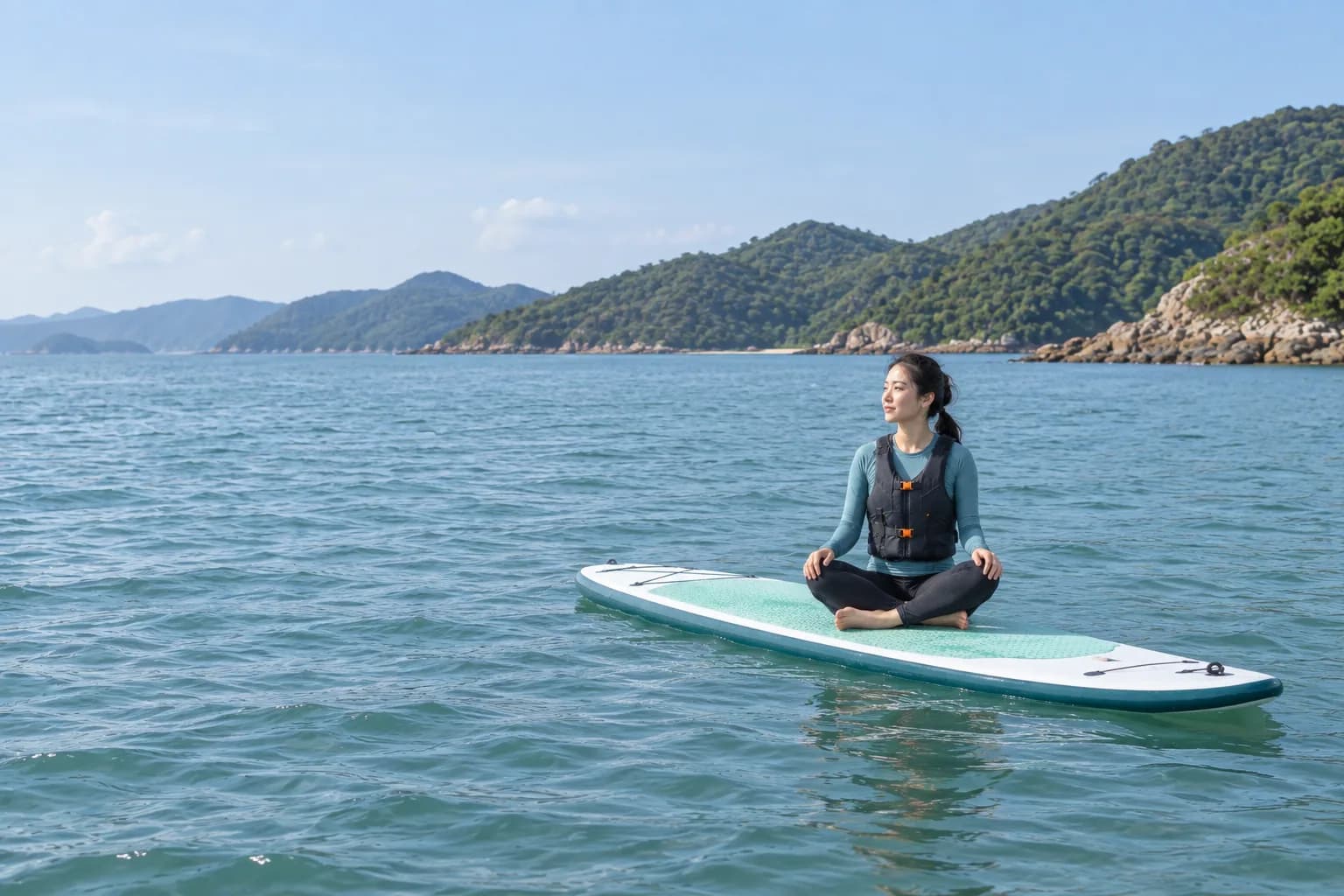
A familiar stretch feels different on a gently moving paddleboard. Stand-up paddleboard yoga, or SUP yoga, combines breathing, movement and balance on the water, inviting you to slow down and notice each shift in weight.
A first session can begin with seated positions and hands-and-knees support, with other poses selected by an instructor for the conditions and your ability. This guide covers the practice, 17 movement groups and their variations, and preparation for a Sai Kung experience.
The cover, pose and equipment images in this article are illustrations in a photographic style, not photographs of Kayarine sessions. Actual equipment, locations and class arrangements may differ.
The Sai Kung SUP Yoga experience at a glance
| Item | What to know |
|---|---|
| Activities | Shore-based safety briefing, basic paddling, SUP yoga and free time for photographs |
| Duration | Approximately two hours, adjusted for weather, sea conditions and participants |
| Participants | Ages 12 and above; the activity page states that no yoga or SUP experience is required |
| Included | A rigid SUP board, paddle, buoyancy aid and instructor guidance |
| Prices and spaces | Select the booking mode, date and party size on the activity page to view the per-person price and total |
What can you get from SUP yoga?
Practise balance and core control
Small board movements invite you to notice your weight distribution and make gentle adjustments. Even a seated posture can be an opportunity to practise coordination and stability.
Stretch within a comfortable range
Seated side stretches and cat–cow offer gentle movement for the shoulders, back and hips. Keep breathing normally and use a range that suits you, without trying to match the depth shown in a picture.
Focus on breathing and movement
Responding to the board encourages attention to your body and the present moment. It is an opportunity to spend time outdoors, slow your pace and enjoy moving with awareness.
REI discusses body control and mindful practice in its SUP yoga guide. NCCIH reports possible stress-management and balance benefits from research on yoga generally. Those studies do not establish guaranteed results from a single SUP yoga session.
REI: SUP Yoga Basics · NCCIH: Yoga — Effectiveness and Safety
17 SUP yoga movement groups: from seated positions to a full flow
This section covers all 17 groups in the REI SUP Yoga pose reference, using 29 individual pose images to show the main phases. Some groups are sequences, so the total is not limited to 17 individual positions. The illustrations keep flotation equipment on and adapt poses to the deck space. This is an introduction to the movements, not a compulsory class plan.
Seated positions and hands-and-knees support can help you get used to the board. Opposite-arm-and-leg balances, reduced hand support, standing poses, squats and sun salutations should be added only when an instructor considers them appropriate. Use a suitable range and do not feel you must complete every pictured pose.
Movement index
- Seated breathing
- Seated spinal flexion and extension
- Arm circles
- Seated side stretches
- Seated twists
- Cat–cow flow
- Leg extensions, knee crunches and bird dog
- Downward-facing dog
- Low-lunge and hamstring-stretch flow
- Downward dog to standing forward fold
- Mountain pose
- Sun-salutation flow
- Yoga squat
- Seated forward fold
- Bridge pose
- Supine twist
- Savasana: resting on the board
1. Seated breathing
Choose a comfortable, stable seat near the centre of the board, resting your hands on your knees and relaxing your shoulders. The photo uses a cross-legged seat. The straddled seat in the reference is another option for an instructor to assess for the board and conditions. Notice your breathing and the board’s small movements before adding motion.
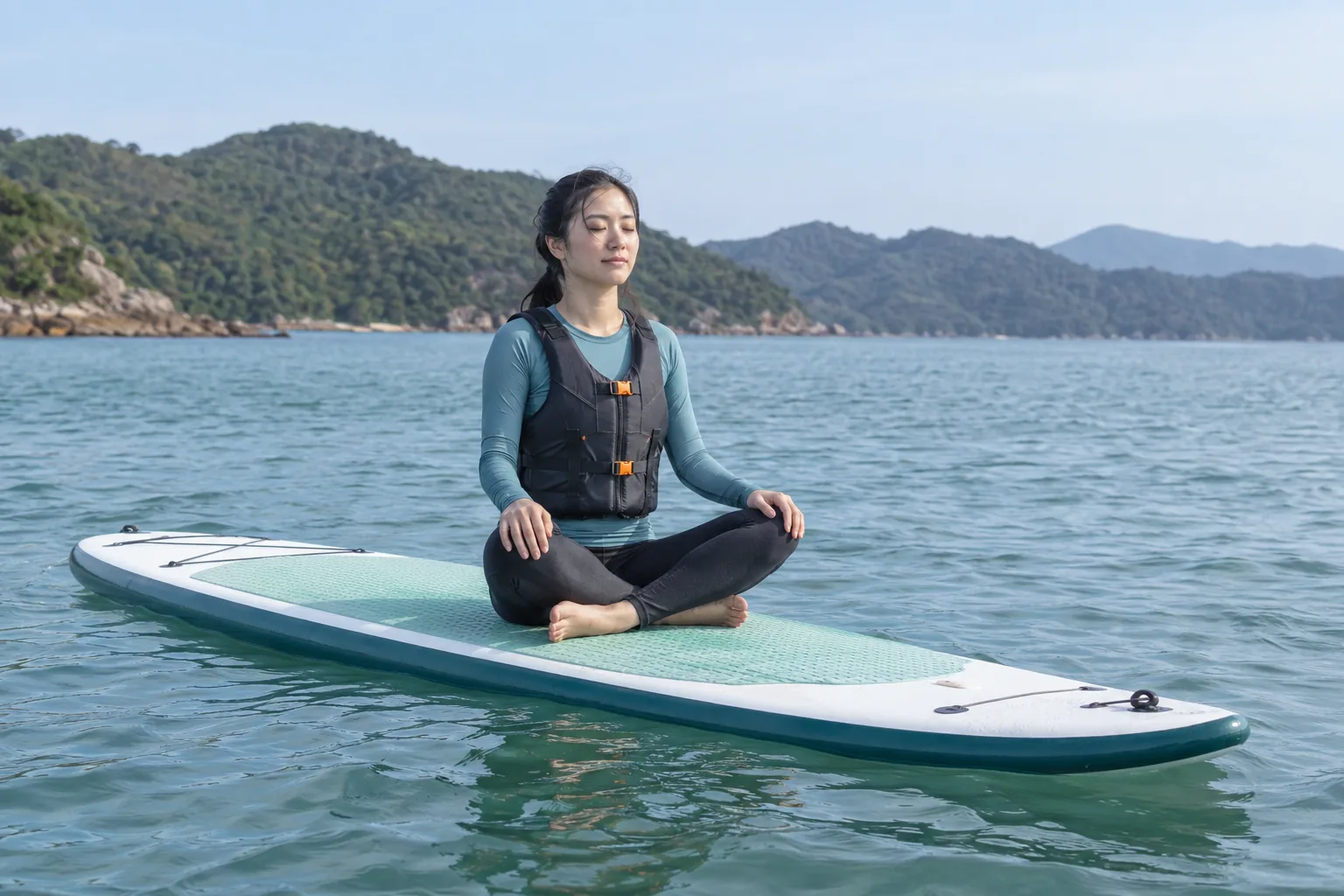
Practice focus:A starting point: get comfortable sitting before progressing to standing.
2. Seated spinal flexion and extension
Keep your sitting bones steady. Gently lift your chest as you inhale, then softly round your upper back as you exhale, keeping your hands on your knees. This is a small movement, rather than a deep backbend or forward fold. Let your neck follow naturally without tipping your head far back.
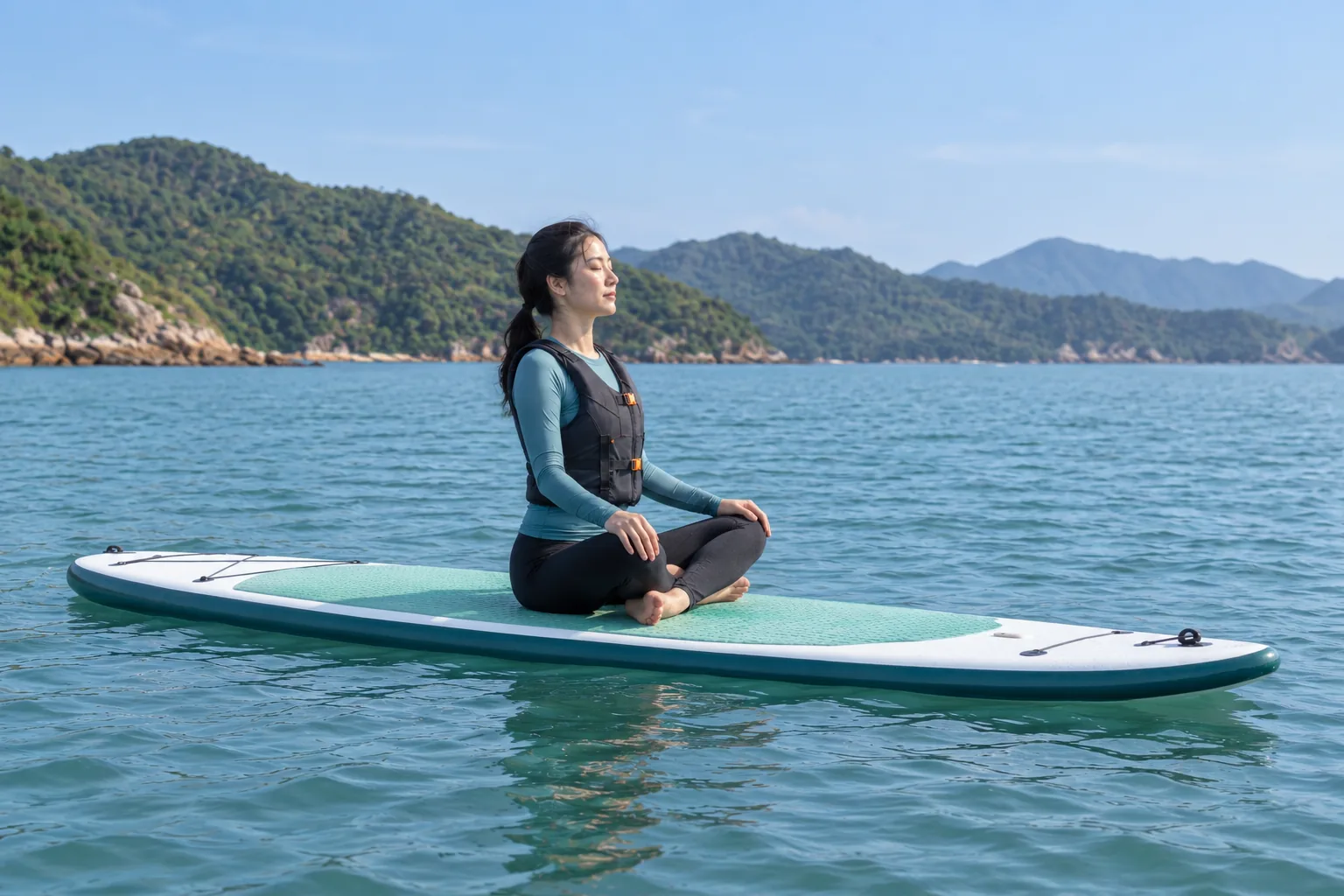
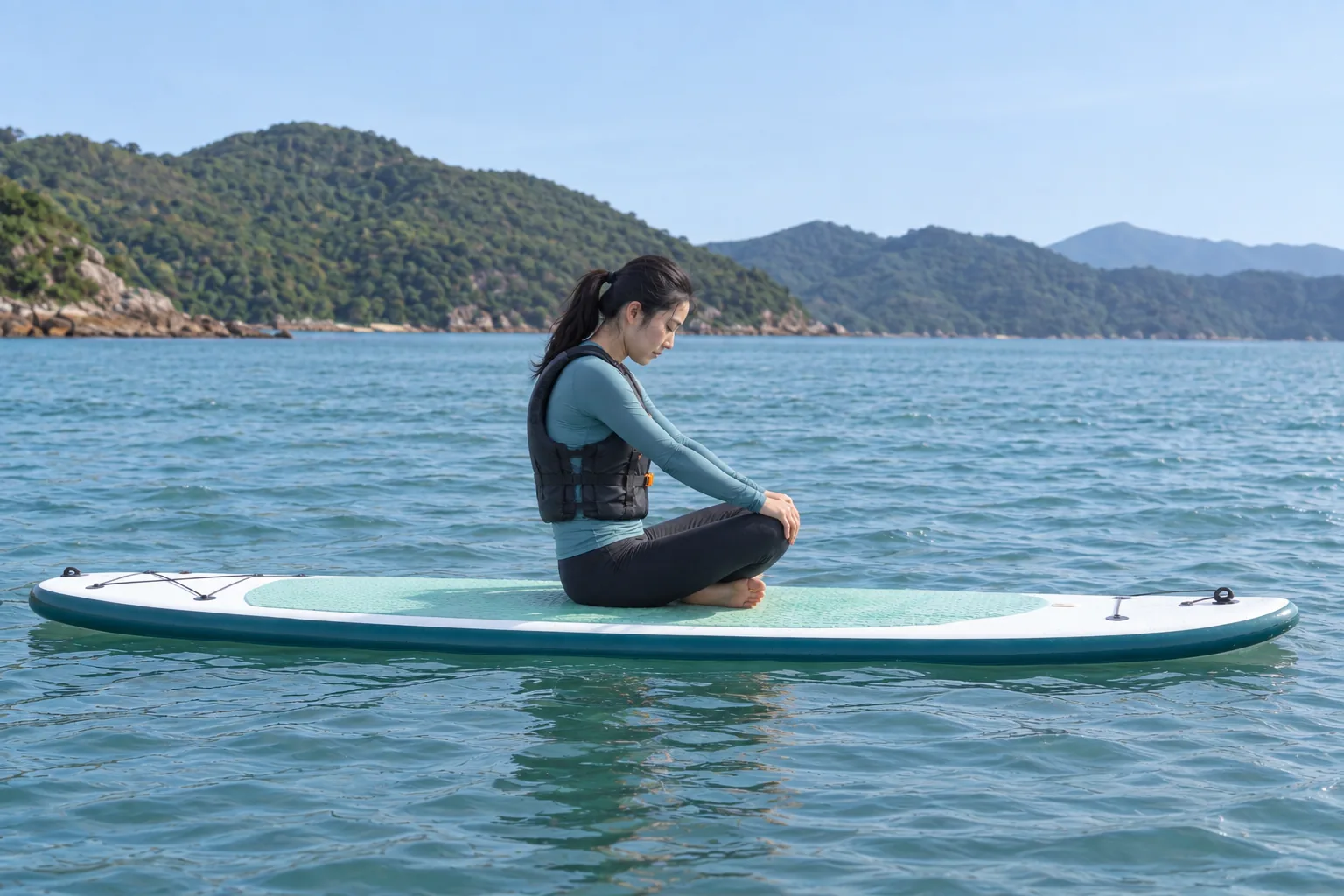
Practice focus:Alternate the two phases at an easy breathing pace; avoid holding your breath.
3. Arm circles
From a stable seat, bring your hands near your chest, reach them forward and upward, then slowly sweep them out to the sides and down to return to the start. The two photos show the raised and outward-sweeping phases. Use a smaller arc or lower arm height if that feels better for your shoulders.
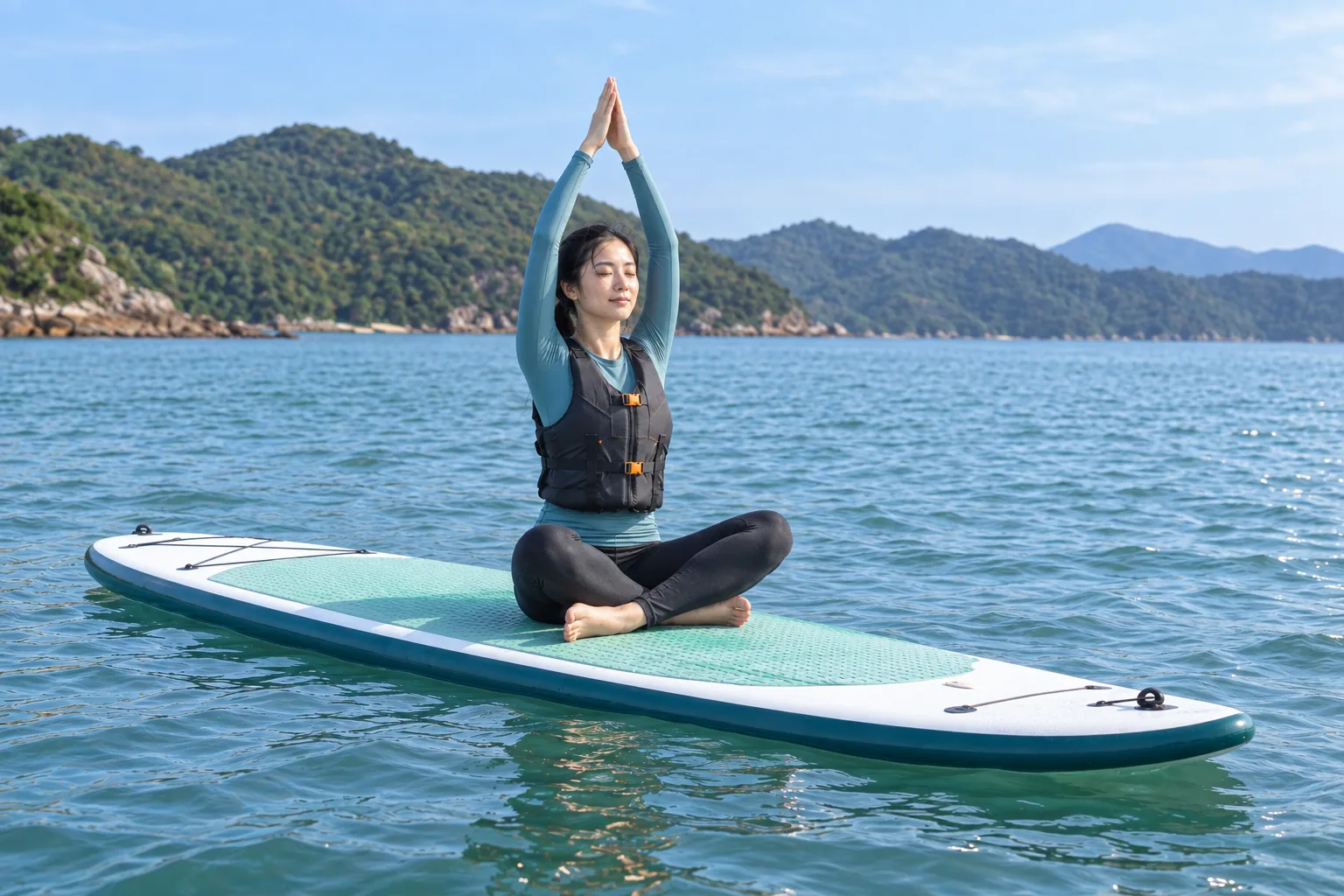
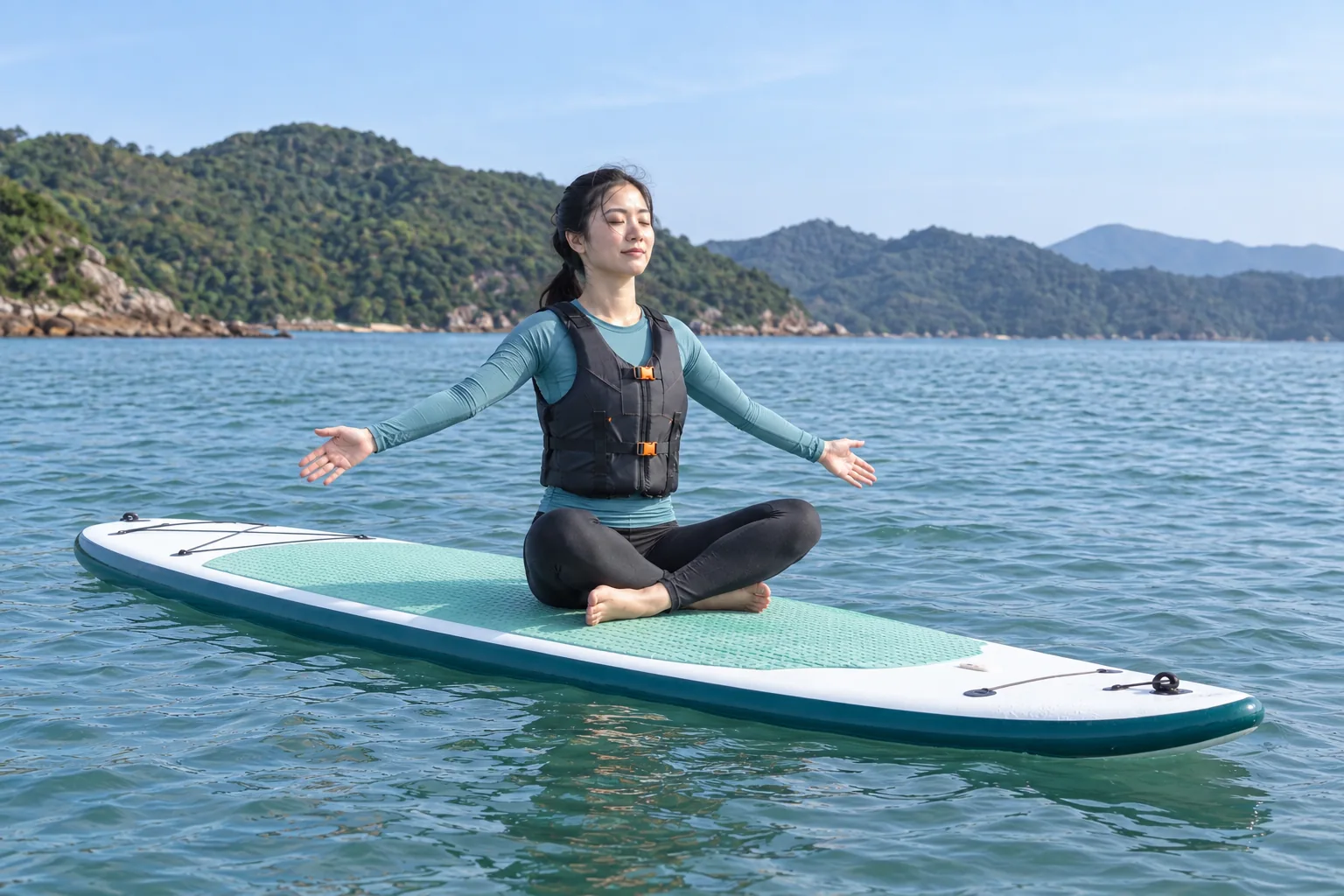
Practice focus:Keep your torso steady as the arms move.
4. Seated side stretches
Support yourself lightly with one hand on the deck and reach the other arm overhead into a gentle side bend. Return to the centre before switching sides. Keep both sitting bones close to the deck instead of tipping your whole body sideways for a deeper stretch.
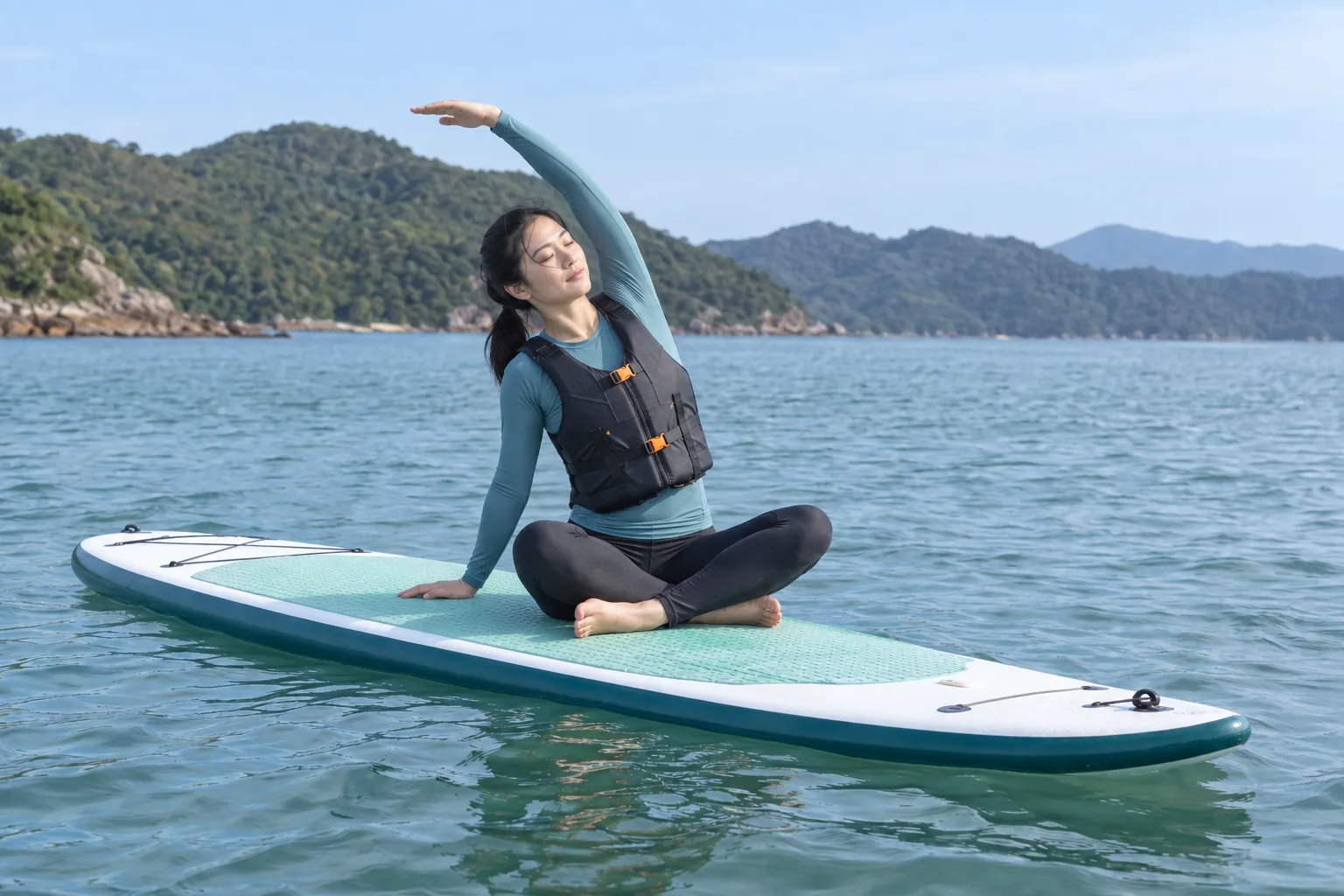
Practice focus:Establish support first, then bend a little to each side.
5. Seated twists
Sit steadily and lengthen through your back. Rest one hand on the opposite knee and the other behind you on the deck, then slowly rotate your chest. Return to the centre before switching sides. Avoid pulling yourself around with your hands or forcing your neck to turn farther.
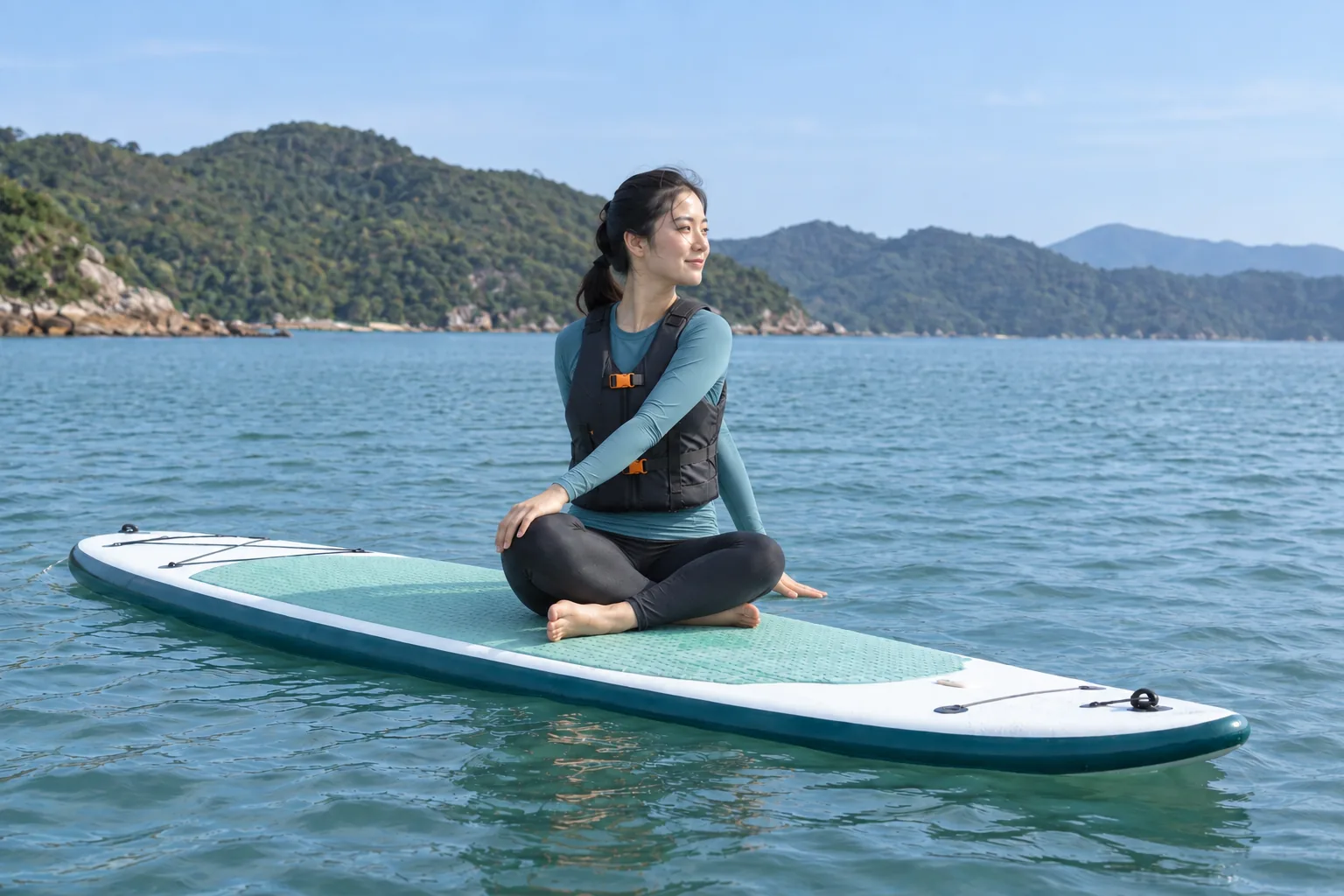
Practice focus:Use a gentle torso rotation, a steady pelvis and natural breathing.
6. Cat–cow flow
Place your hands and knees near the centre of the board. In cow, gently move your chest forward and let the abdomen lower slightly; in cat, slowly round your back and soften your chin downward. Separate images show both phases. Keep your hands and knees steady throughout the transition.
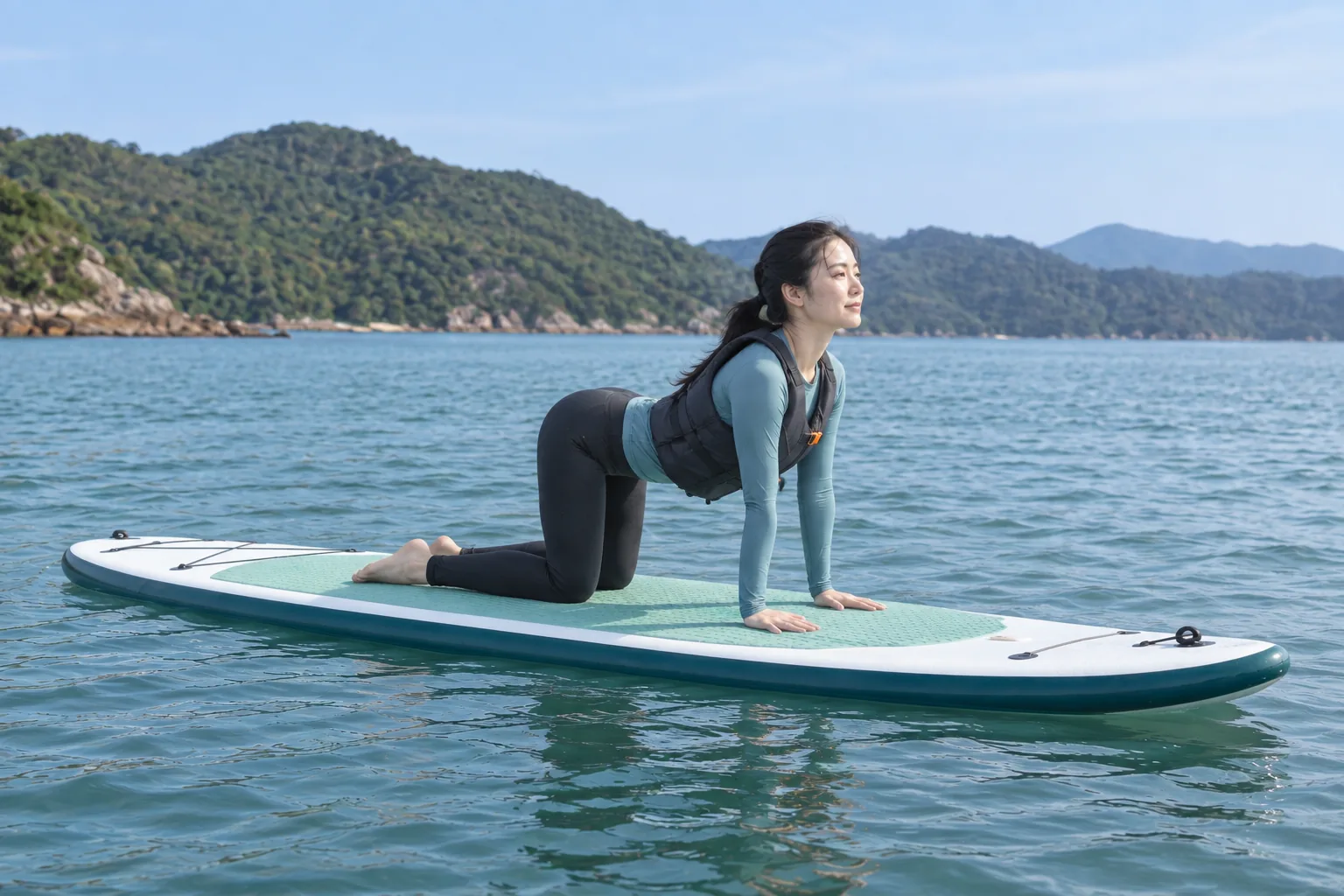
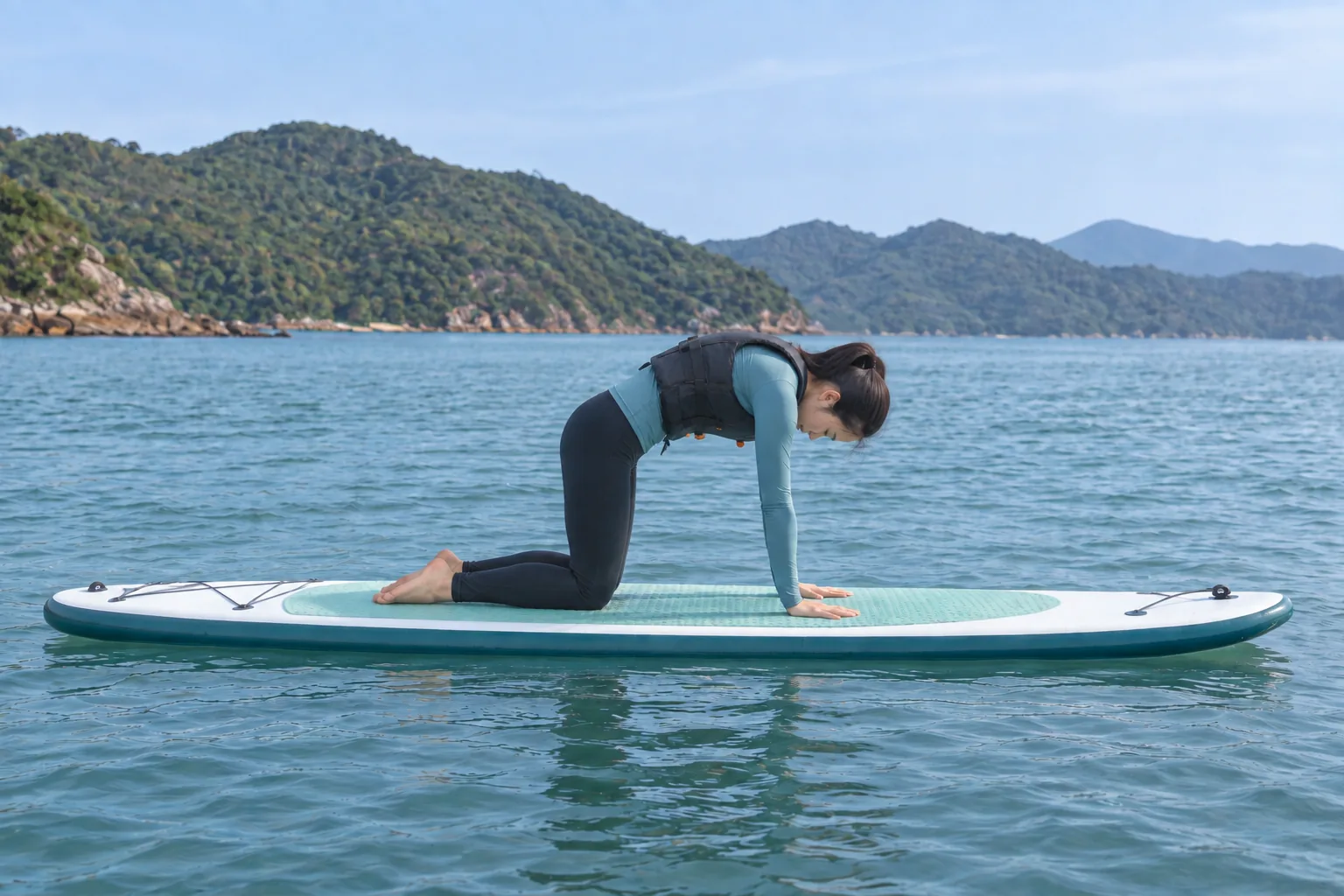
Practice focus:A low-centre-of-gravity movement: keep the range modest and avoid compressing your lower back.
7. Leg extensions, knee crunches and bird dog
Begin on all fours with both hands supporting you. Extend one leg behind, then bend that knee and draw it gently beneath your torso. Practise on both sides. Once you are stable, an instructor may add a hold with the opposite arm reaching forward, known as bird dog.
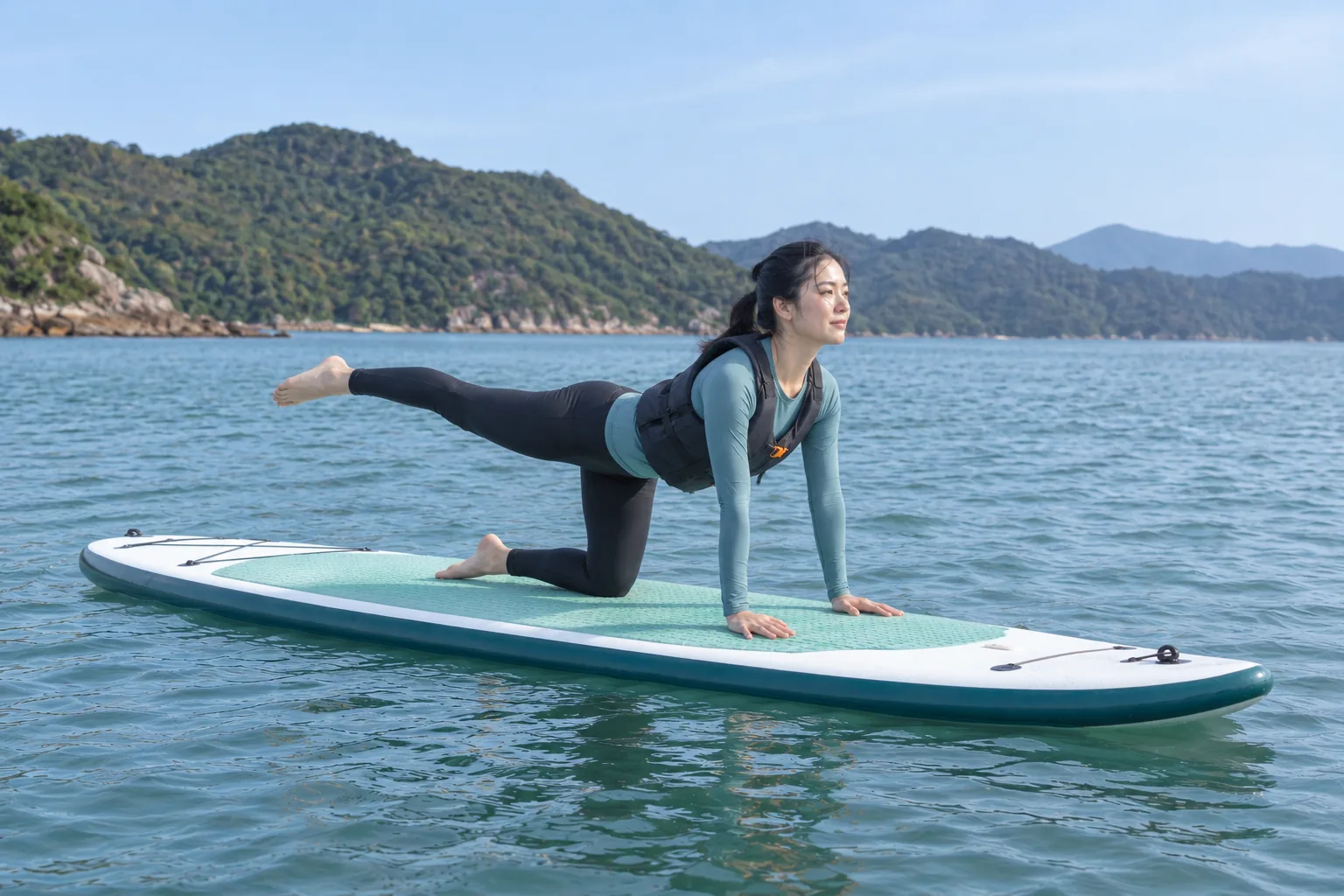
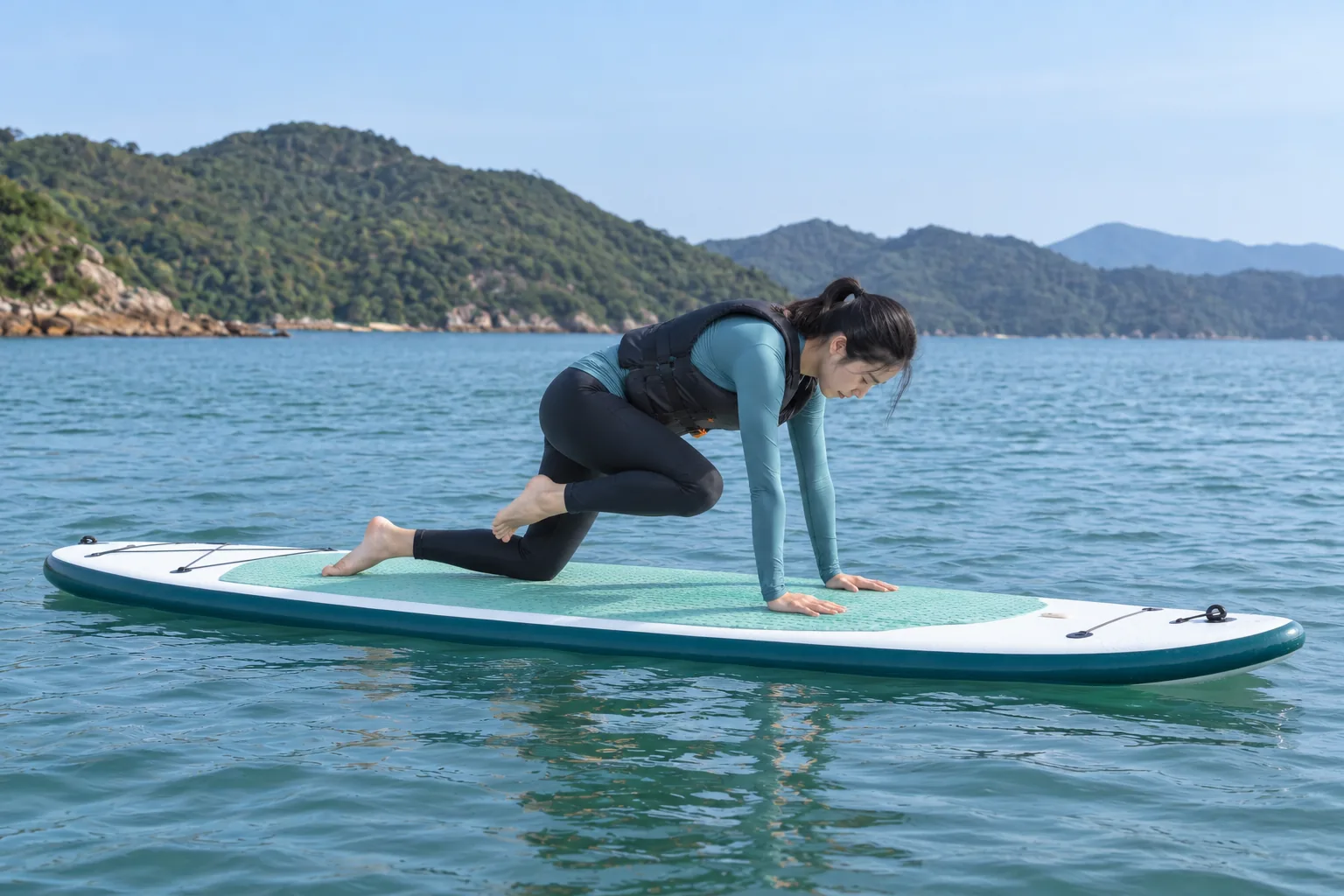
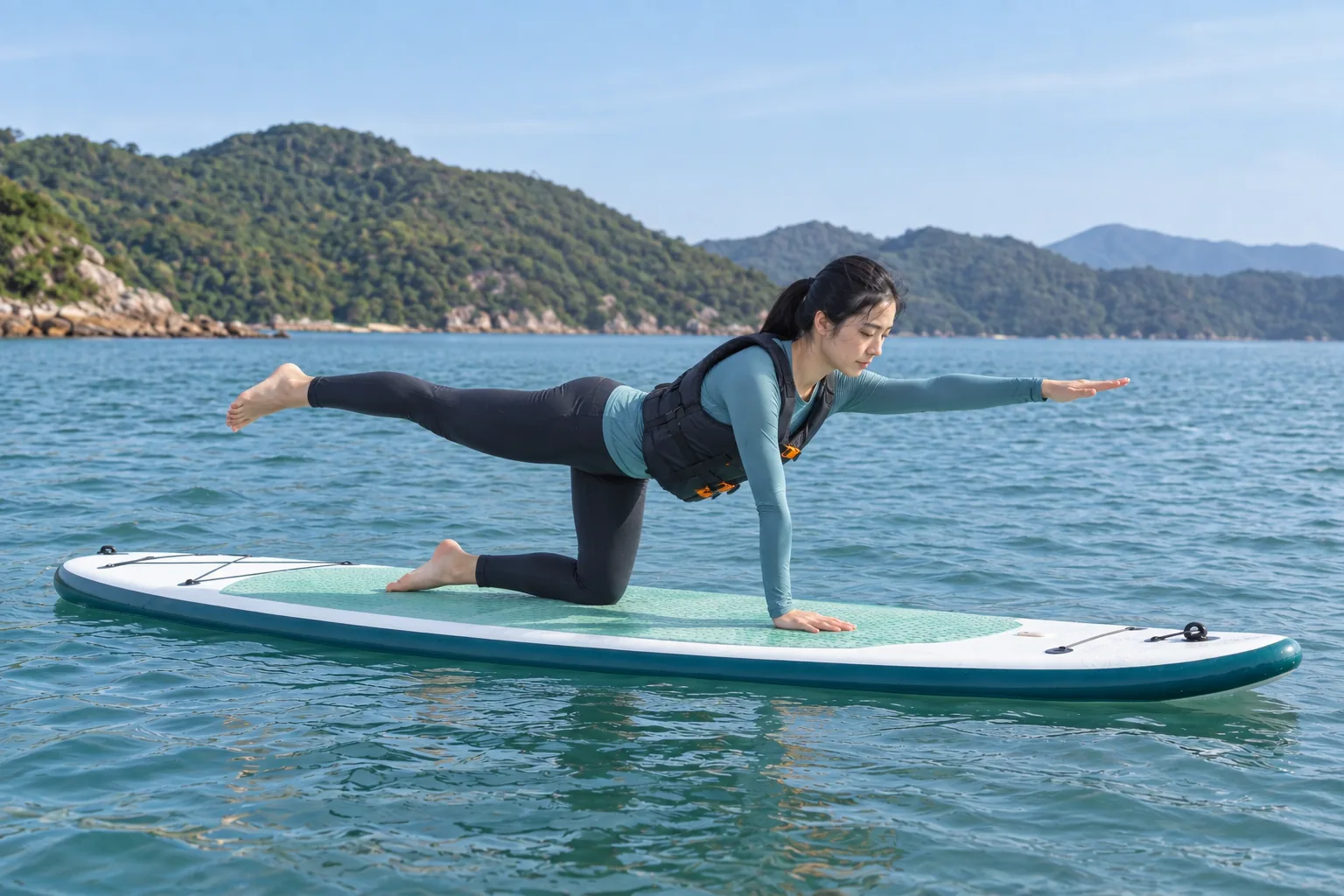
Practice focus:The three phases progressively challenge balance; the arm reach is optional.
8. Downward-facing dog
With an instructor’s guidance, press into your hands and feet and lift your hips into an inverted V. Your knees may stay bent and your heels do not have to touch the deck. Maintain hand support and space around your shoulders and neck.
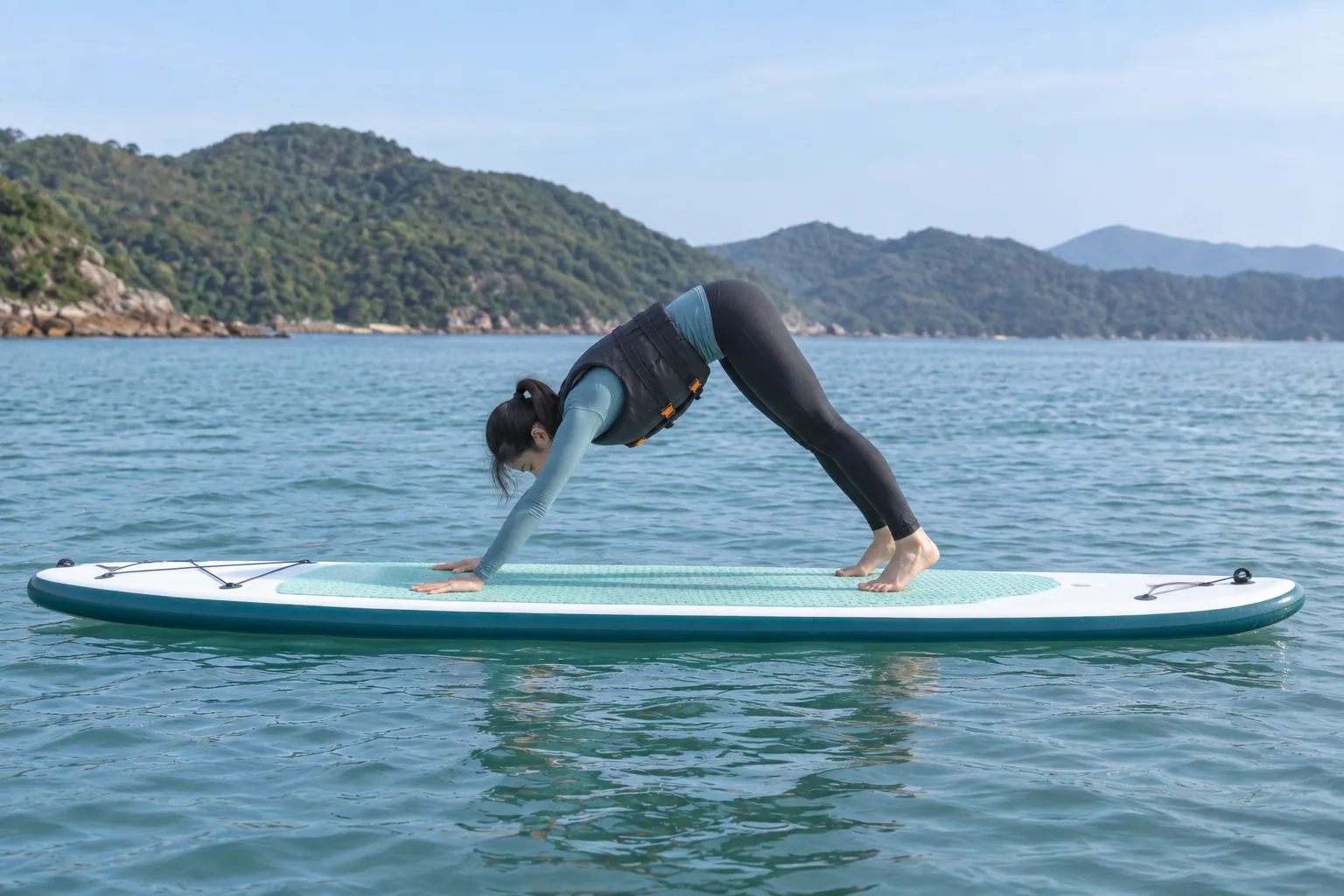
Practice focus:Get comfortable with hands-and-knees support before lifting both knees.
9. Low-lunge and hamstring-stretch flow
Step one foot forward with the back knee on the deck and begin with both hands supporting you. If stable, lift your torso and arms, then slowly shift your hips back into a kneeling half split. Keep the front knee soft rather than forcing it straight.
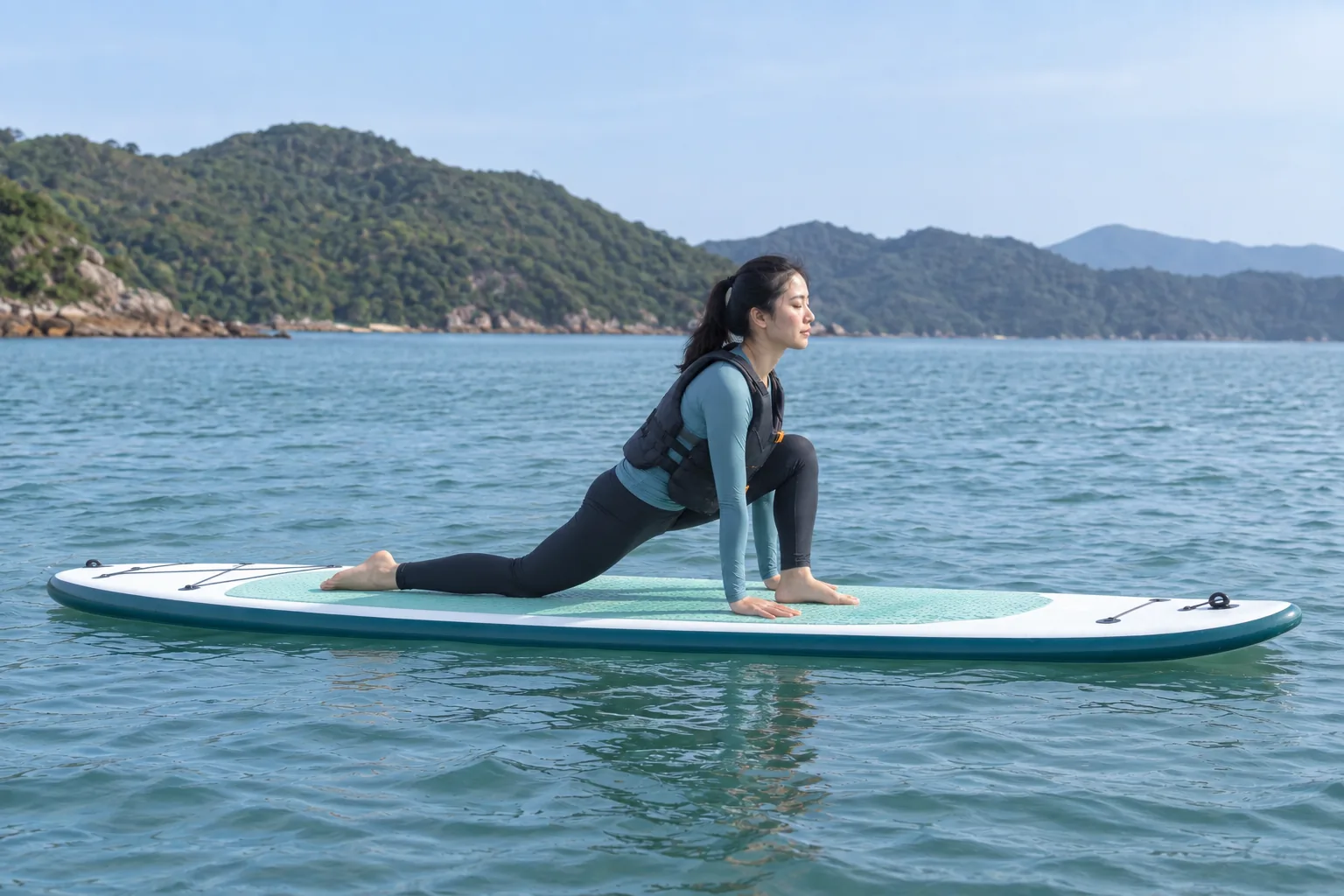
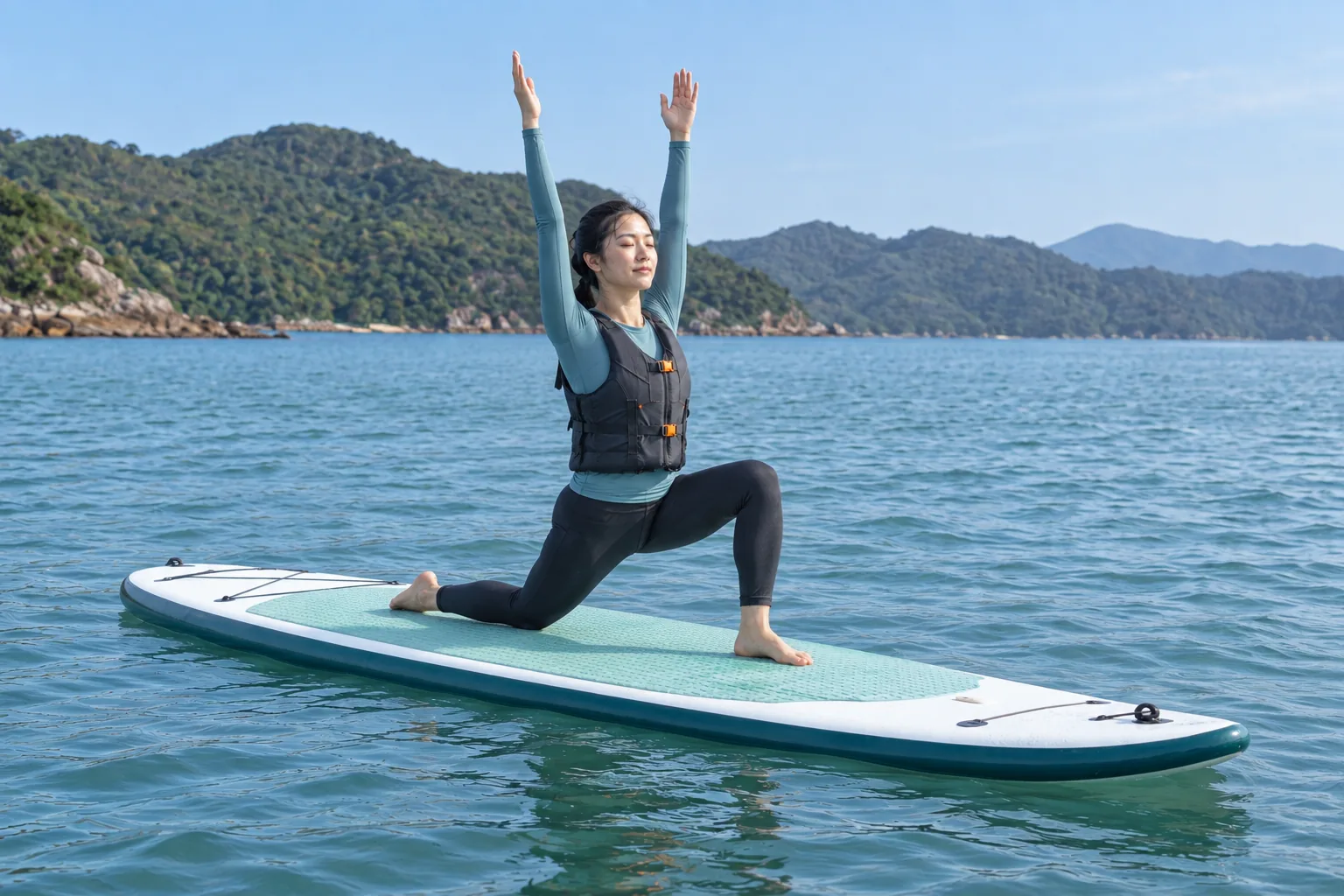
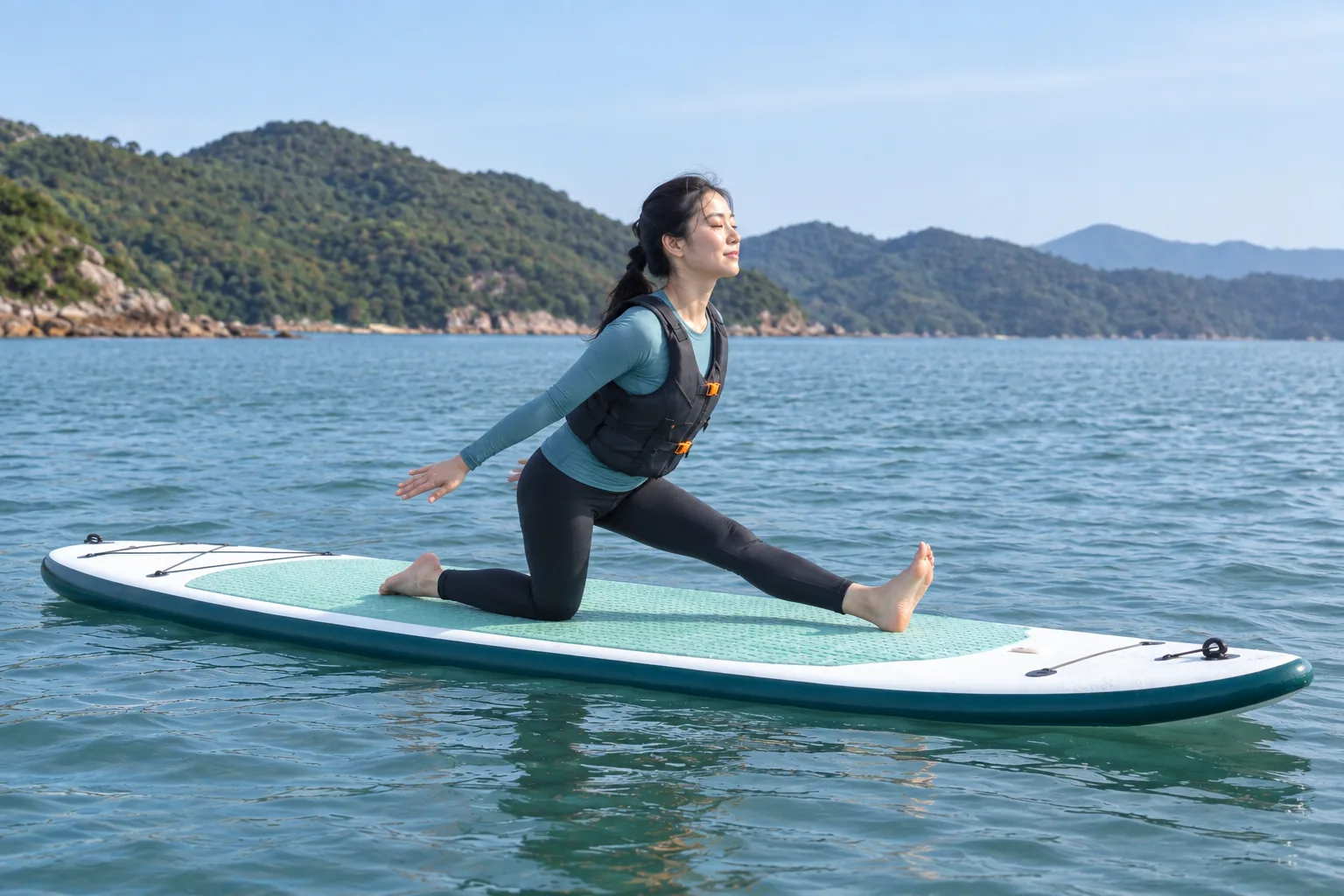
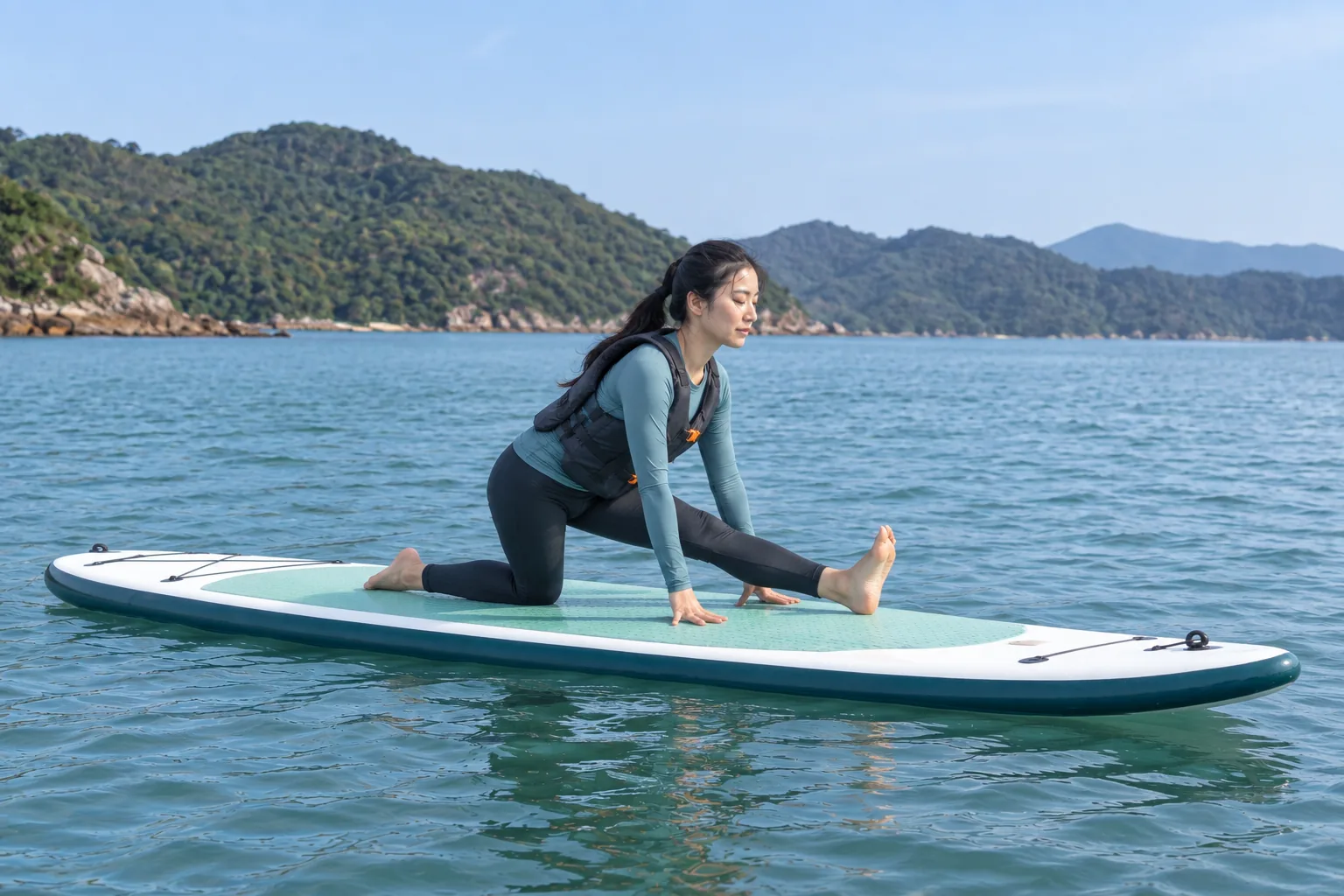
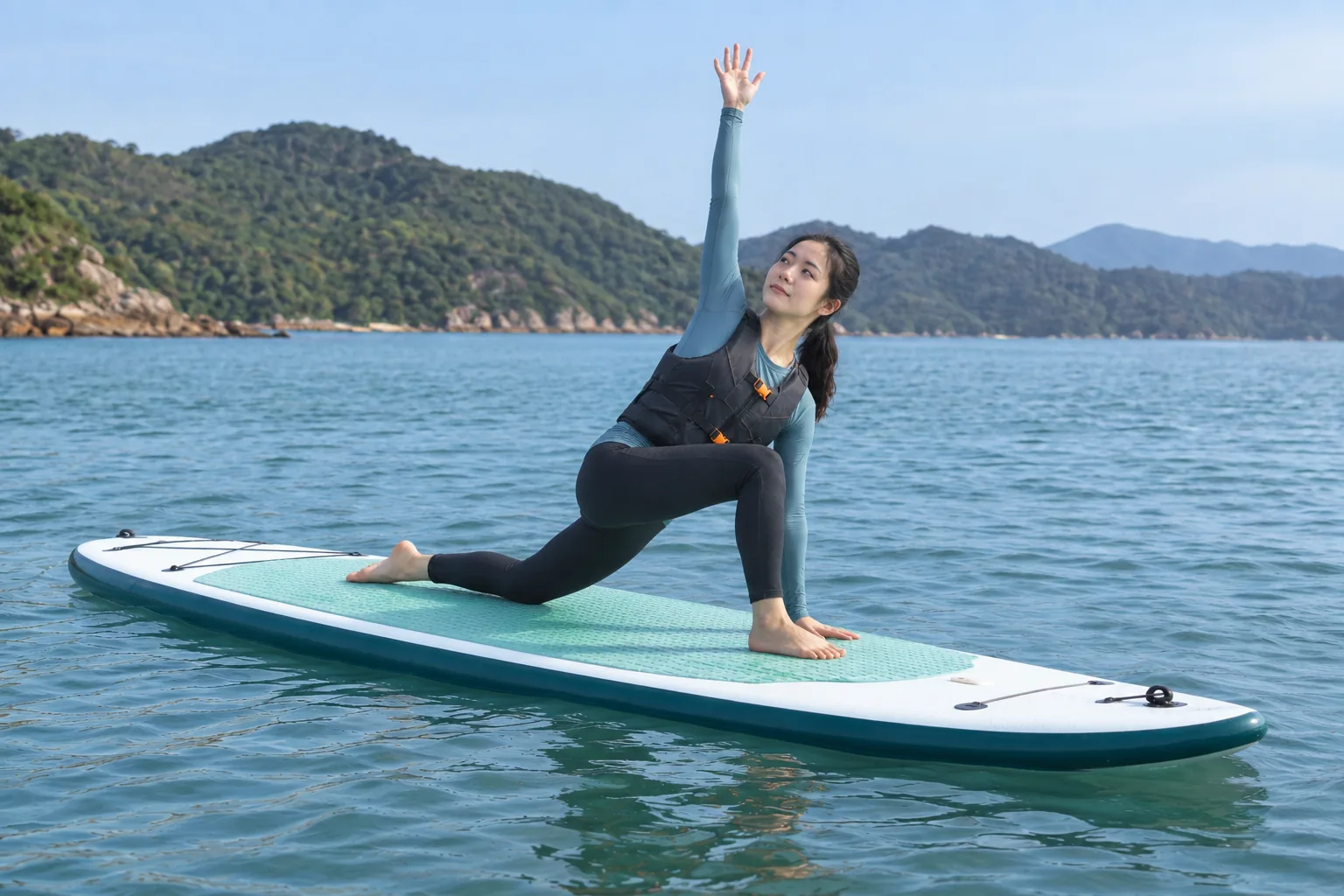
Practice focus:The reference also includes an arms-back transition, a supported half-split hold and a supported twist after returning to low lunge. Each variation is shown below. An instructor can select only the stages with sufficient support; practise the other side when appropriate.
10. Downward dog to standing forward fold
From downward dog, follow your instructor’s guidance to walk your feet towards your hands in small steps and arrive in a standing forward fold. Allow your knees to bend and keep your weight centred. Avoid jumping forward or forcing both legs straight.
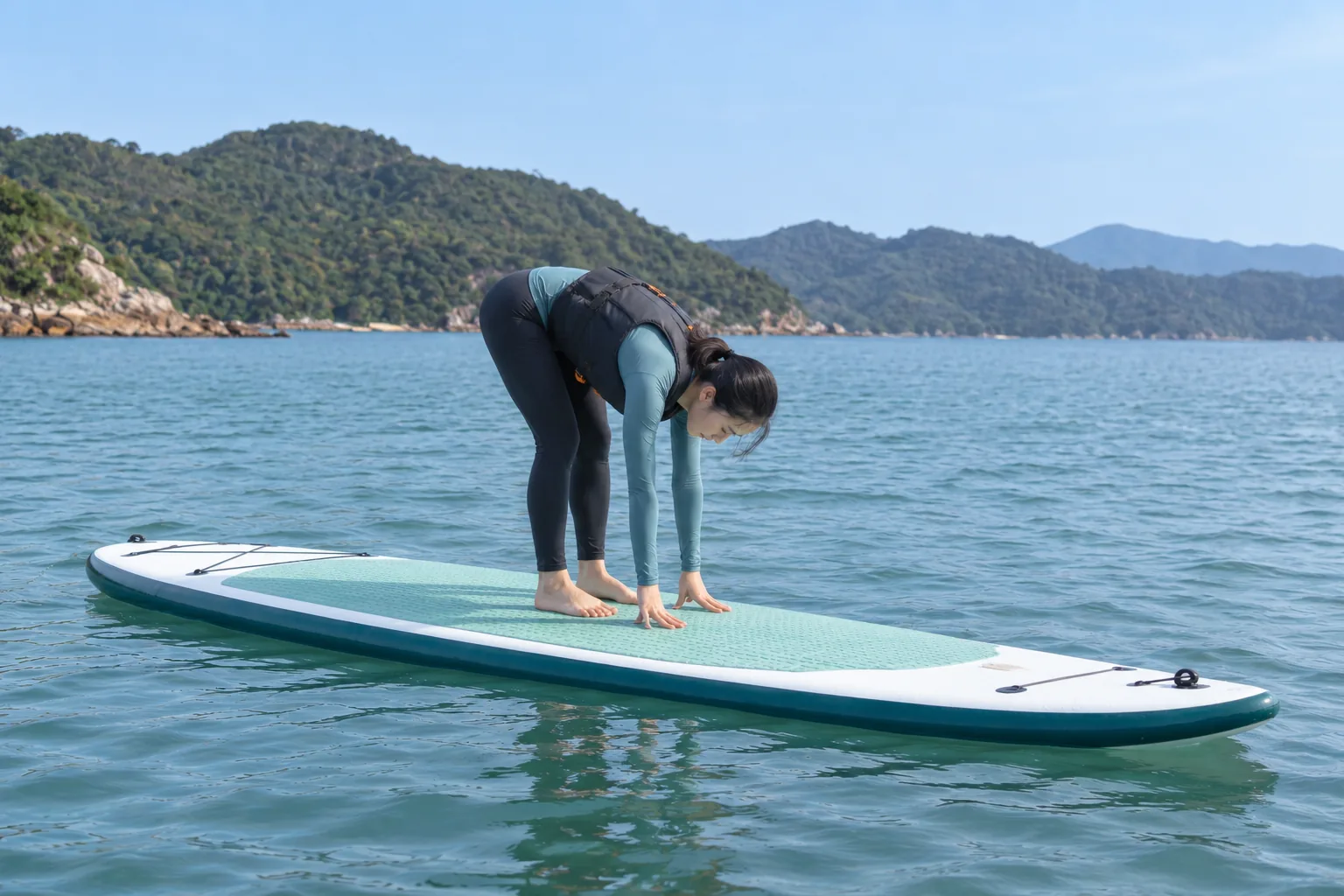
Practice focus:Move your weight gradually; return to kneeling if you feel unstable.
11. Mountain pose
Stand near the centre of the board with feet about hip-width apart and knees soft. Keep your hands near your chest or at your sides, look towards a steady point ahead and notice the weight shared between both feet.
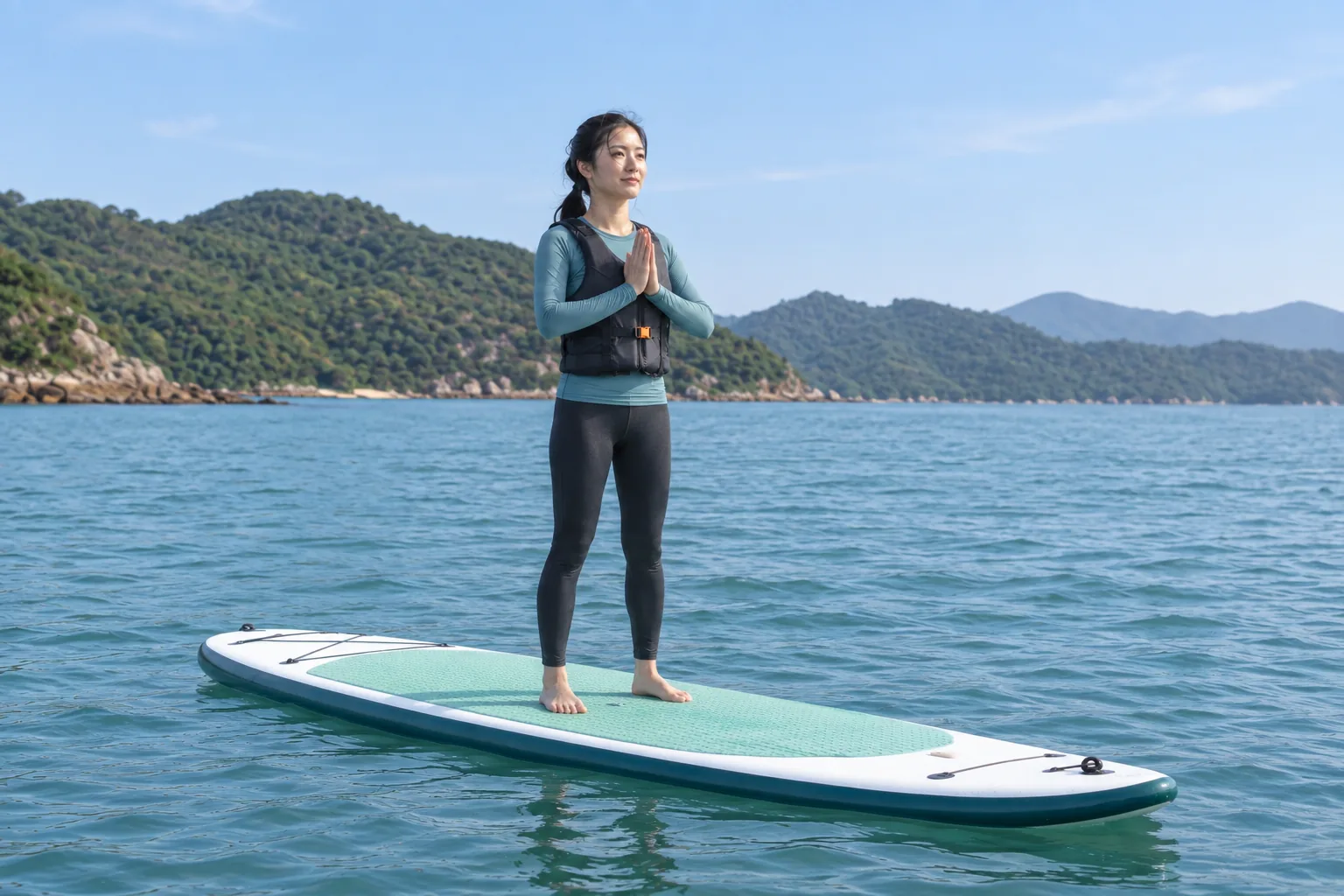
Practice focus:Standing poses depend on conditions and ability; become steady before adding arm movements.
12. Sun-salutation flow
This sequence links several positions and asks more of your weight shifts, arm support and coordination. The complete reference order is listed below to explain how the movements connect. In a class, an instructor may separate the poses, reduce the sequence or use kneeling alternatives.
Complete sequence order
- Upward salute
- Standing forward fold
- Step back to low lunge
- Plank
- Eight-point pose / lower to the belly
- Cobra (a low version is pictured)
- Downward-facing dog
- Step forward to low lunge
- Standing forward fold
- Upward salute
- Return to mountain pose
Stay upright during the upward salute. Plank uses hands and toes for support, with knees lowered when instructed. Establish knee support before an instructor-guided descent towards the belly. A low cobra only needs a small chest lift and the elbows may stay bent. The photos show the additional flow stages; click other step names to revisit the earlier pose images.
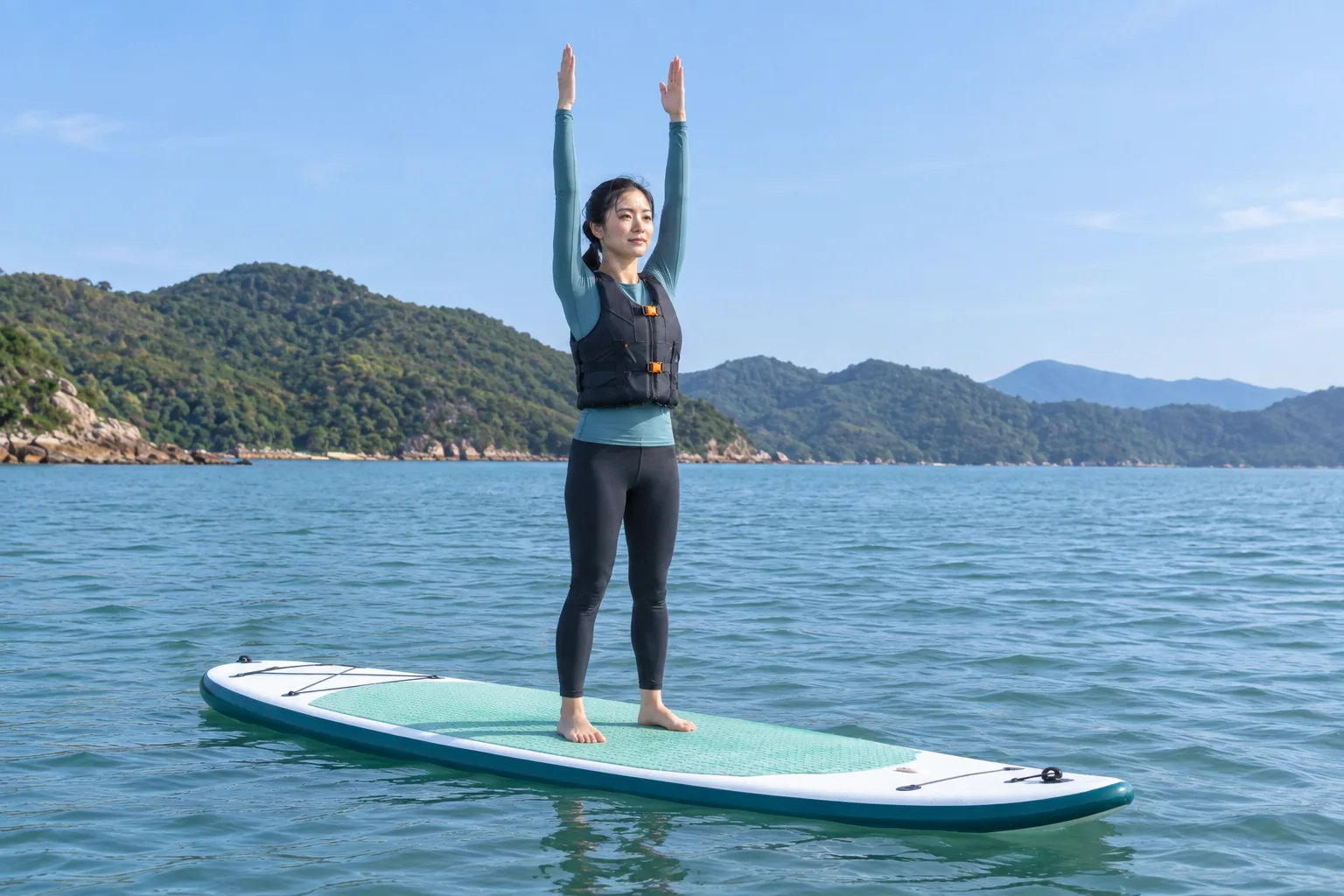
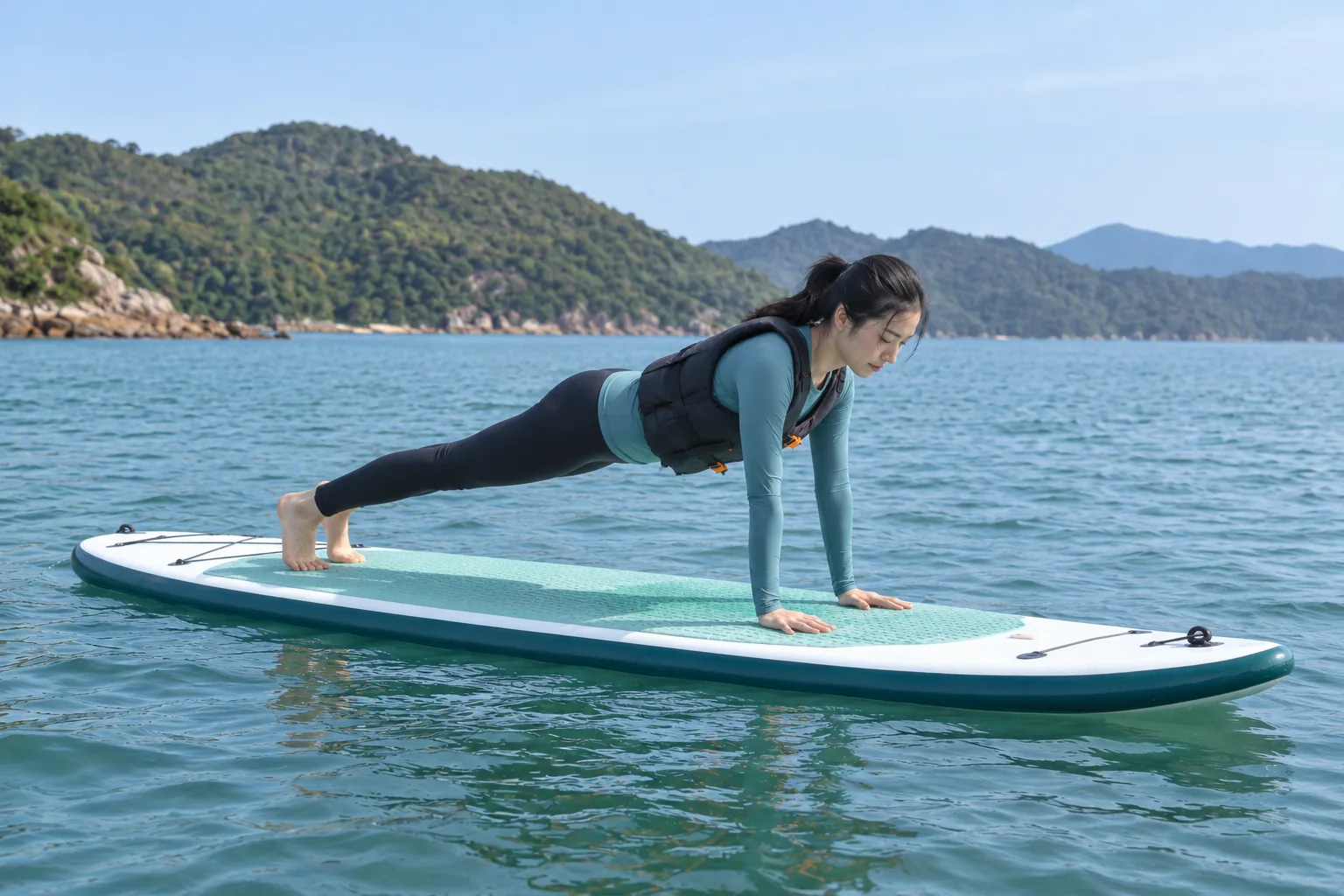
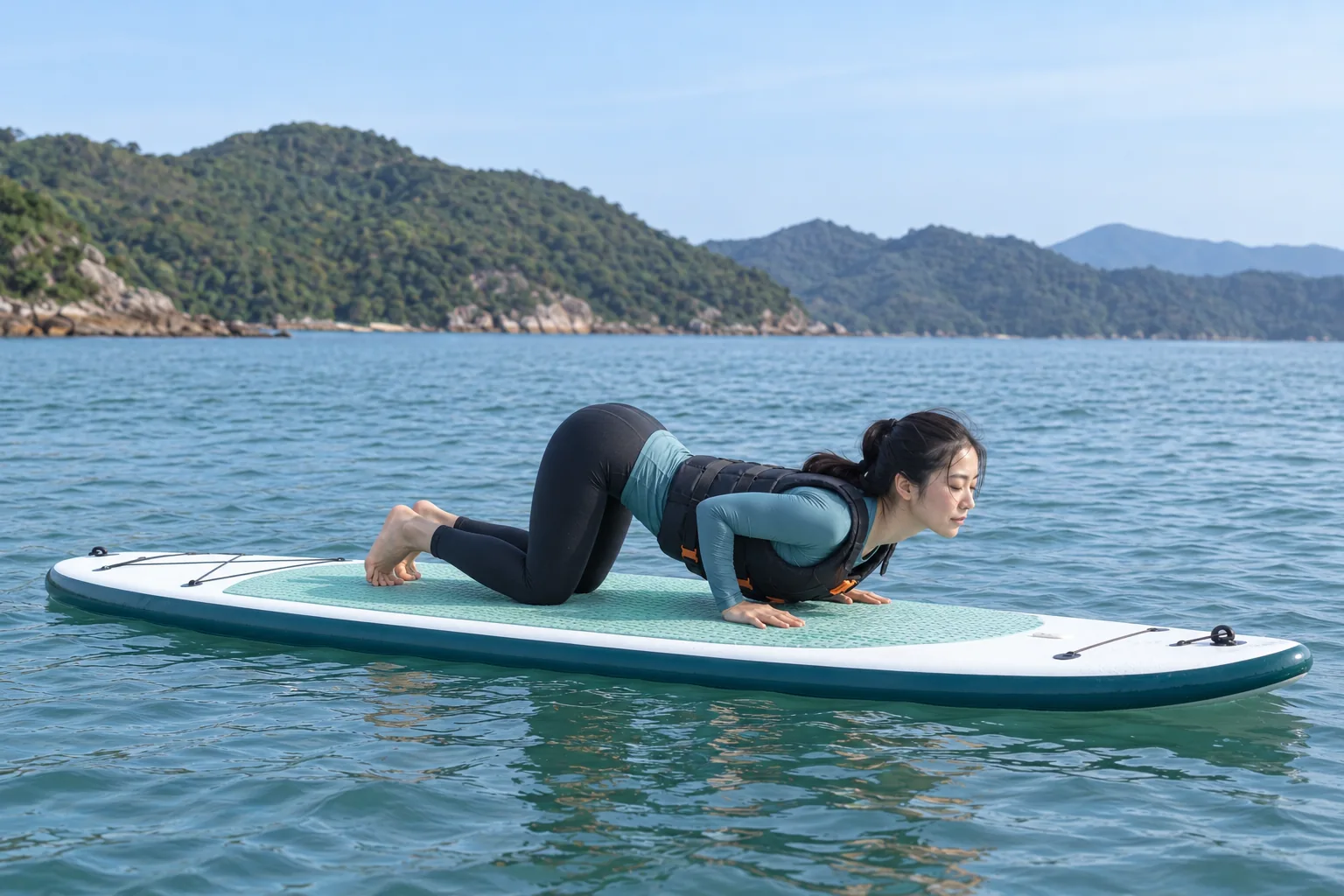
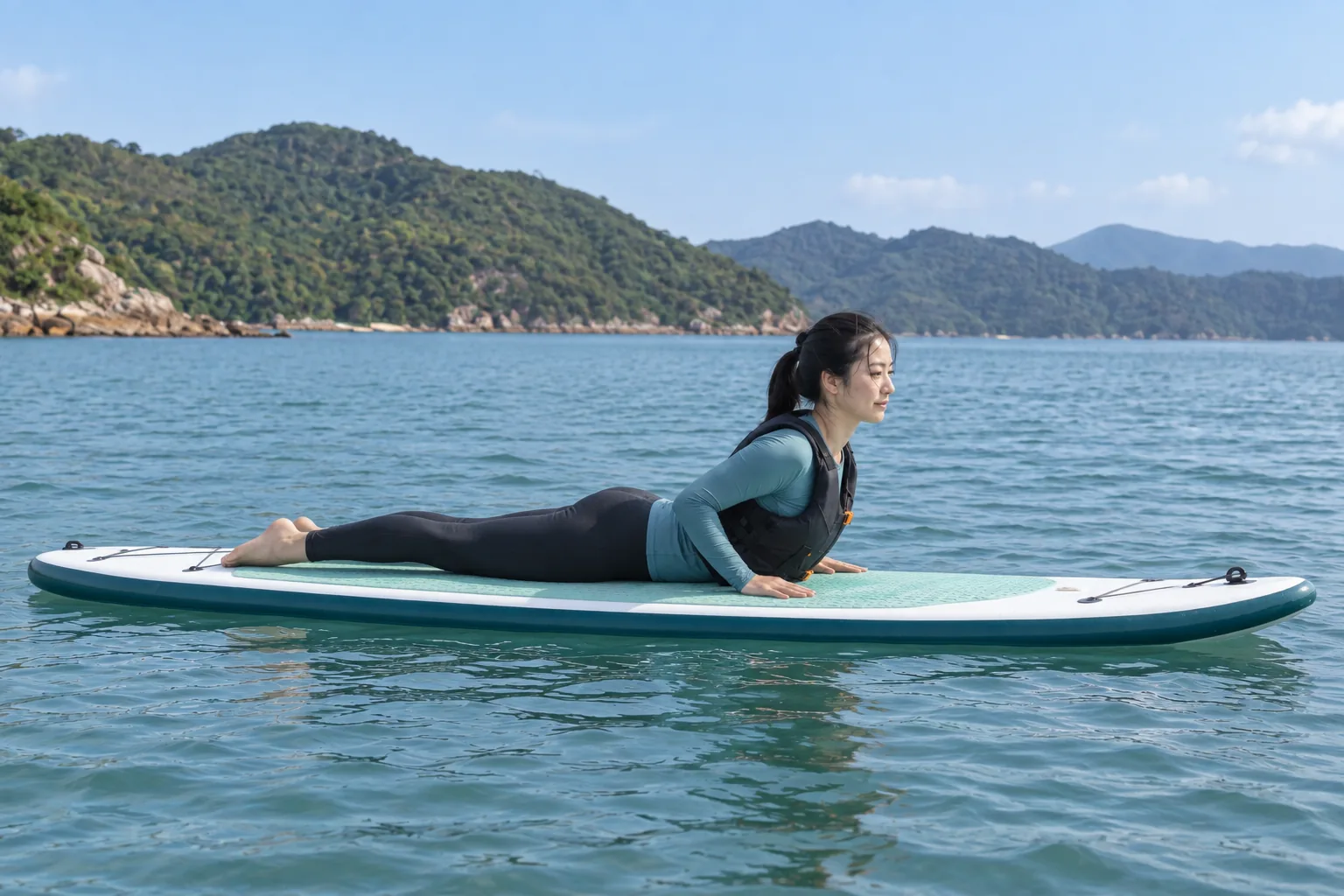
Practice focus:Practise both leading legs when appropriate, with the number of rounds set by your instructor. Eight-point pose lowers the knees, chest and chin. If your flotation equipment restricts this movement, do not force your chest or neck down or remove the equipment; use an instructor-approved descent or skip it.
13. Yoga squat
Place your feet securely on the wider part of the board, turn the toes slightly outward and bend your knees to lower your hips. Keep your chest comfortably lifted; your palms may meet near your chest. Adjust the depth to your ankles, knees and hips rather than trying to match the photo.
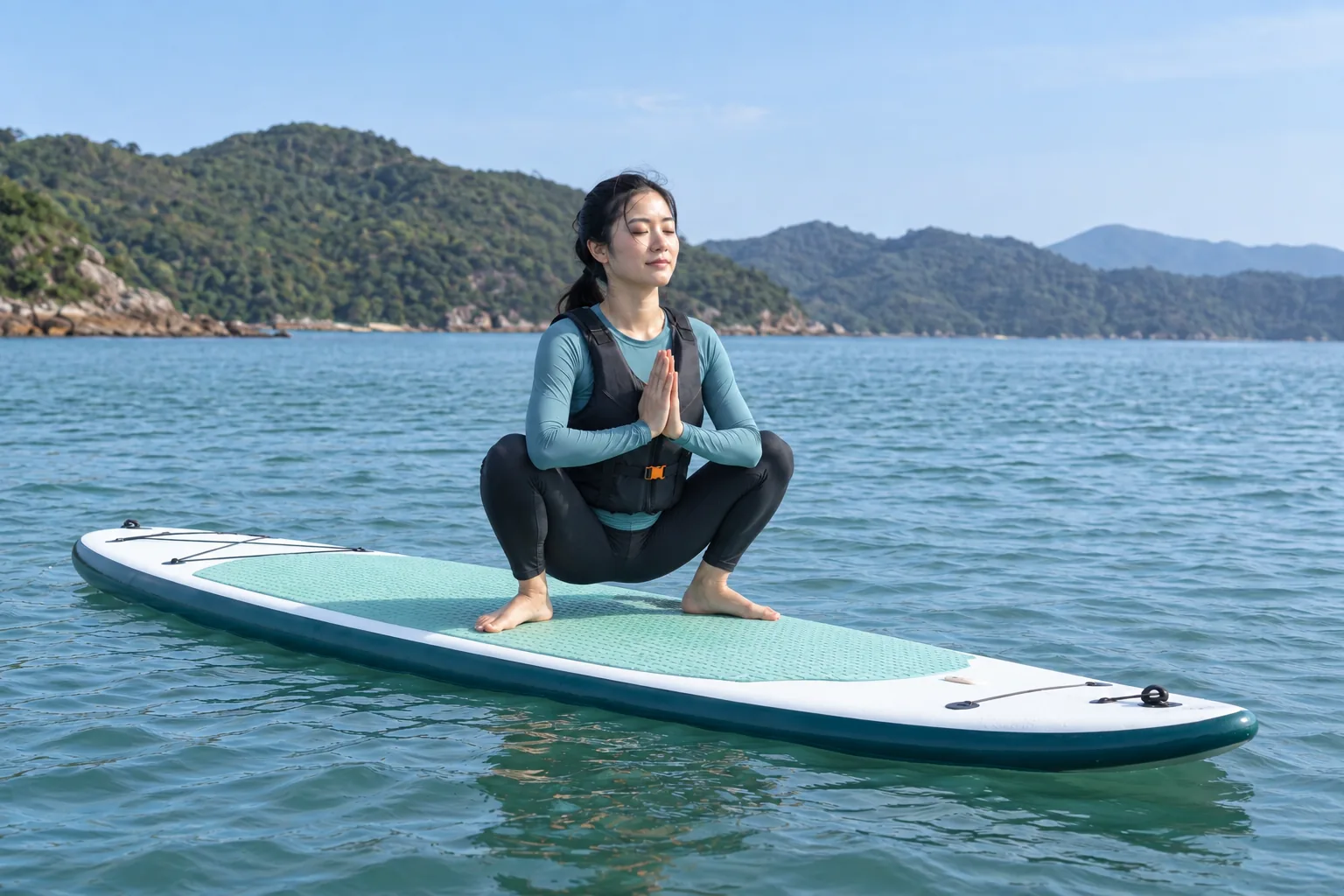
Practice focus:This needs mobility and balance; a shallower squat or a seated alternative may suit you better.
14. Seated forward fold
Extend your legs along the board with soft knees and gently hinge forward from the hips. Your hands can rest on your shins, ankles or beside you without reaching your toes. A stretching strap, as pictured in the reference, is optional; never use a board-securing line as a stretching strap.
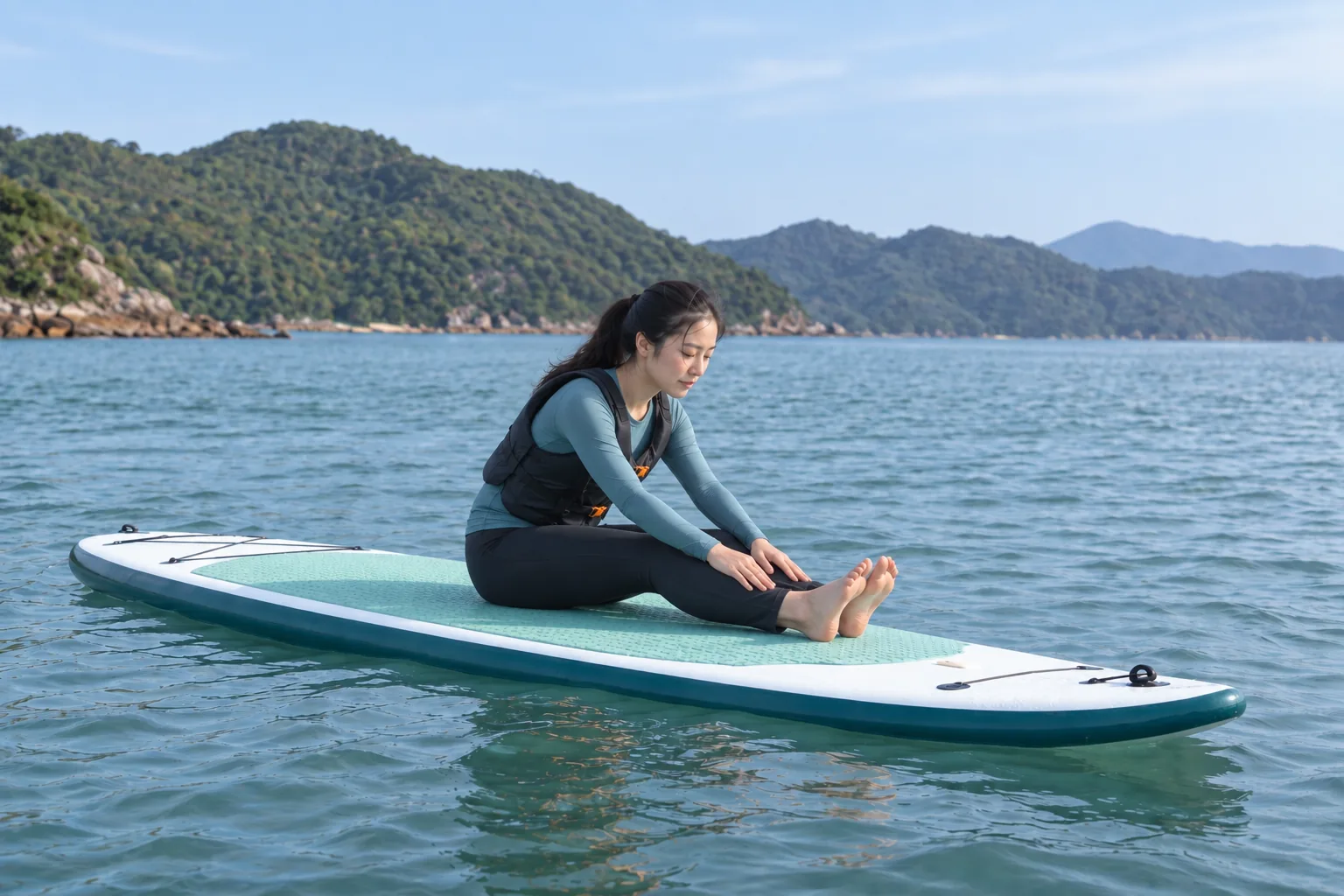
Practice focus:Keep a comfortable length through your back; avoid pulling on your feet or forcing your head towards your knees.
15. Bridge pose
Lie on your back with knees bent, feet secure on the deck and arms beside you. If your instructor confirms it is appropriate, lift your hips a small distance while keeping your shoulders supported, then lower slowly. Do not turn your head while lifted.
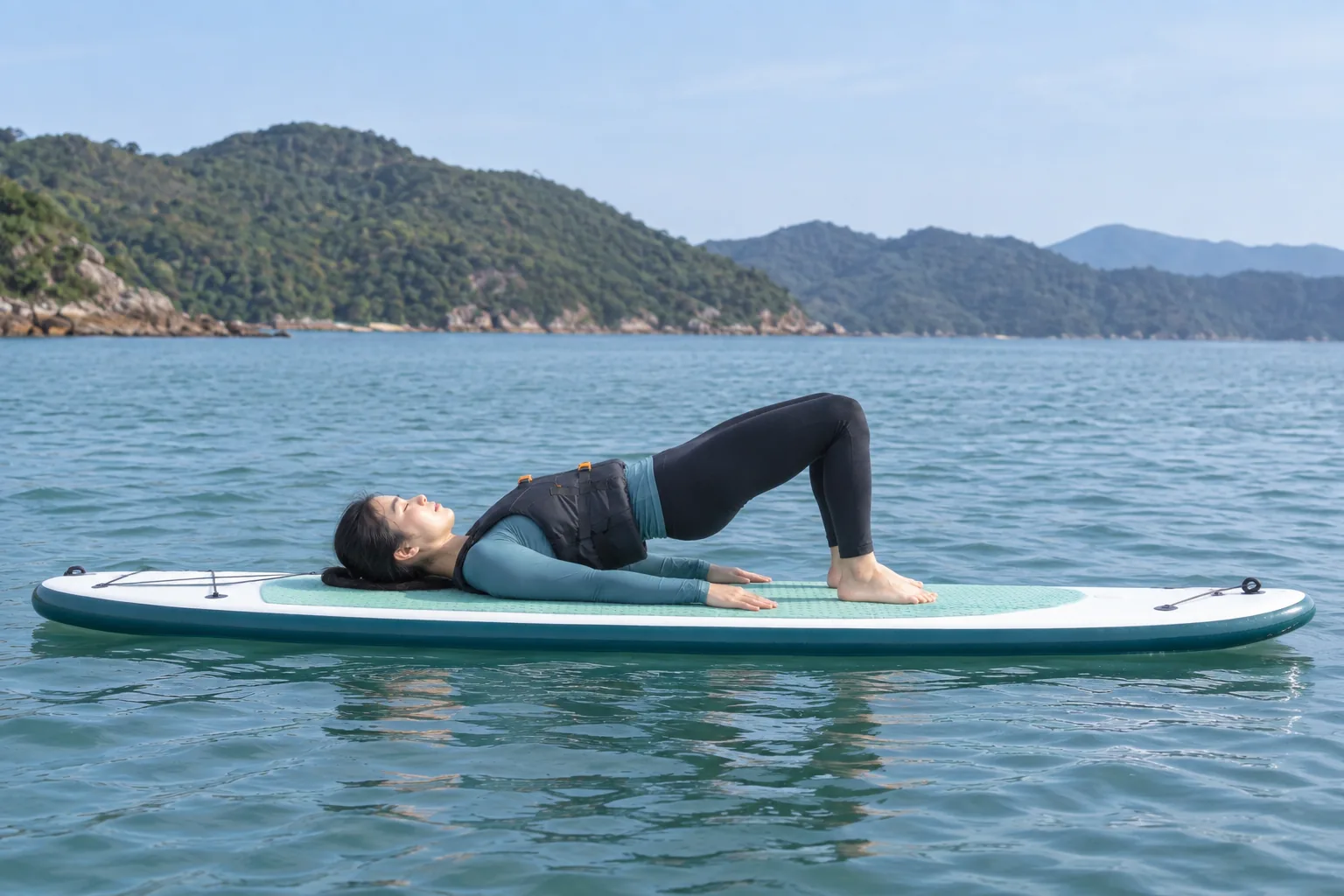
Practice focus:Start small, relax the shoulders and neck, and avoid a sudden lift.
16. Supine twist
Lie along the centre of the board, keeping one leg long while bending the other knee and gently taking it across your body. Keep your shoulders supported and place your arms comfortably within the available deck space. Return to the centre before switching sides; do not force your knee down or into the water.
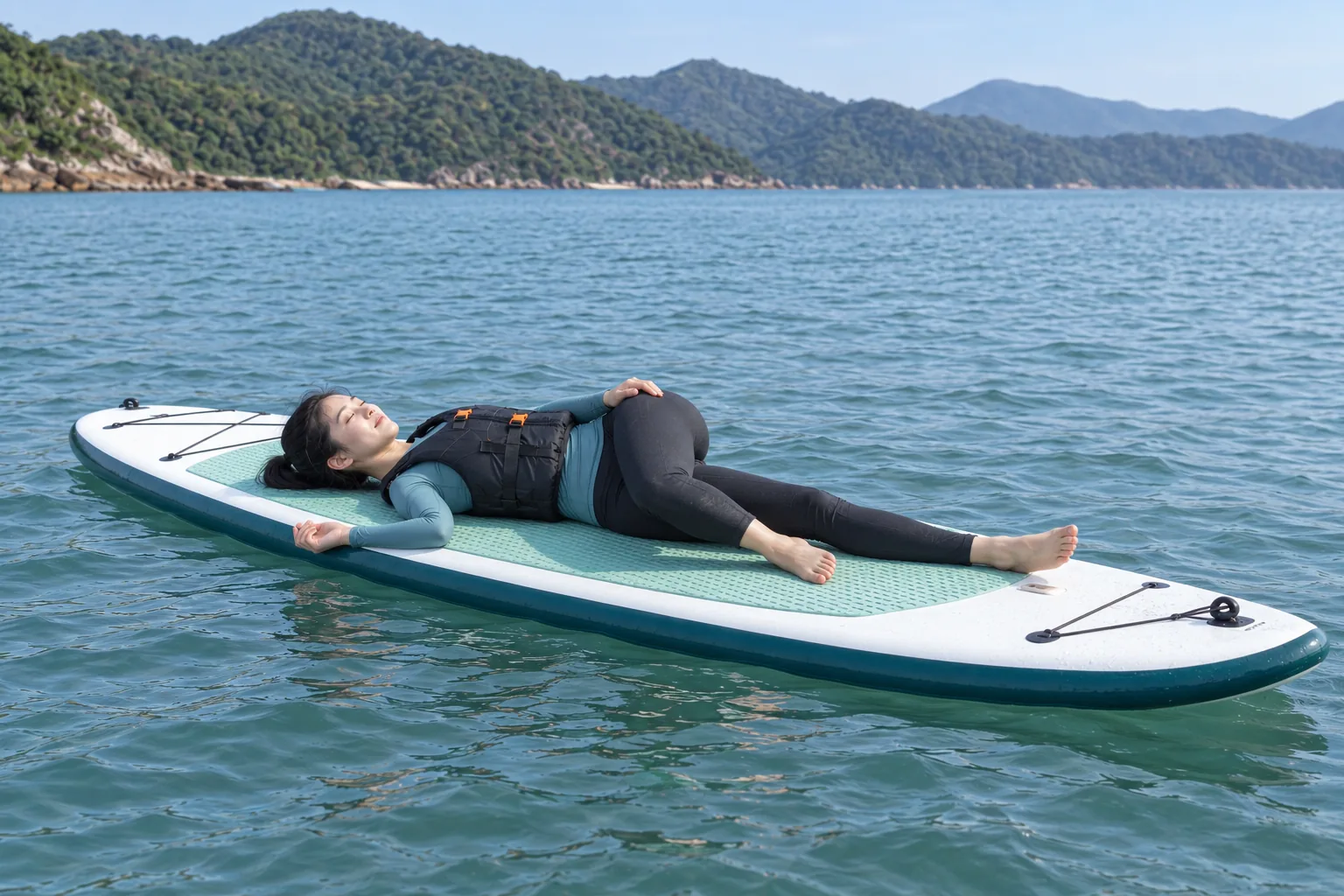
Practice focus:Use a small rotation; a seated twist is an alternative if space or equipment makes this unsuitable.
17. Savasana: resting on the board
Lie along the centre of the board with your arms comfortably beside you and notice your breathing settle. Your instructor will adapt the resting position to the board, conditions and flotation equipment. Sitting is also an option.
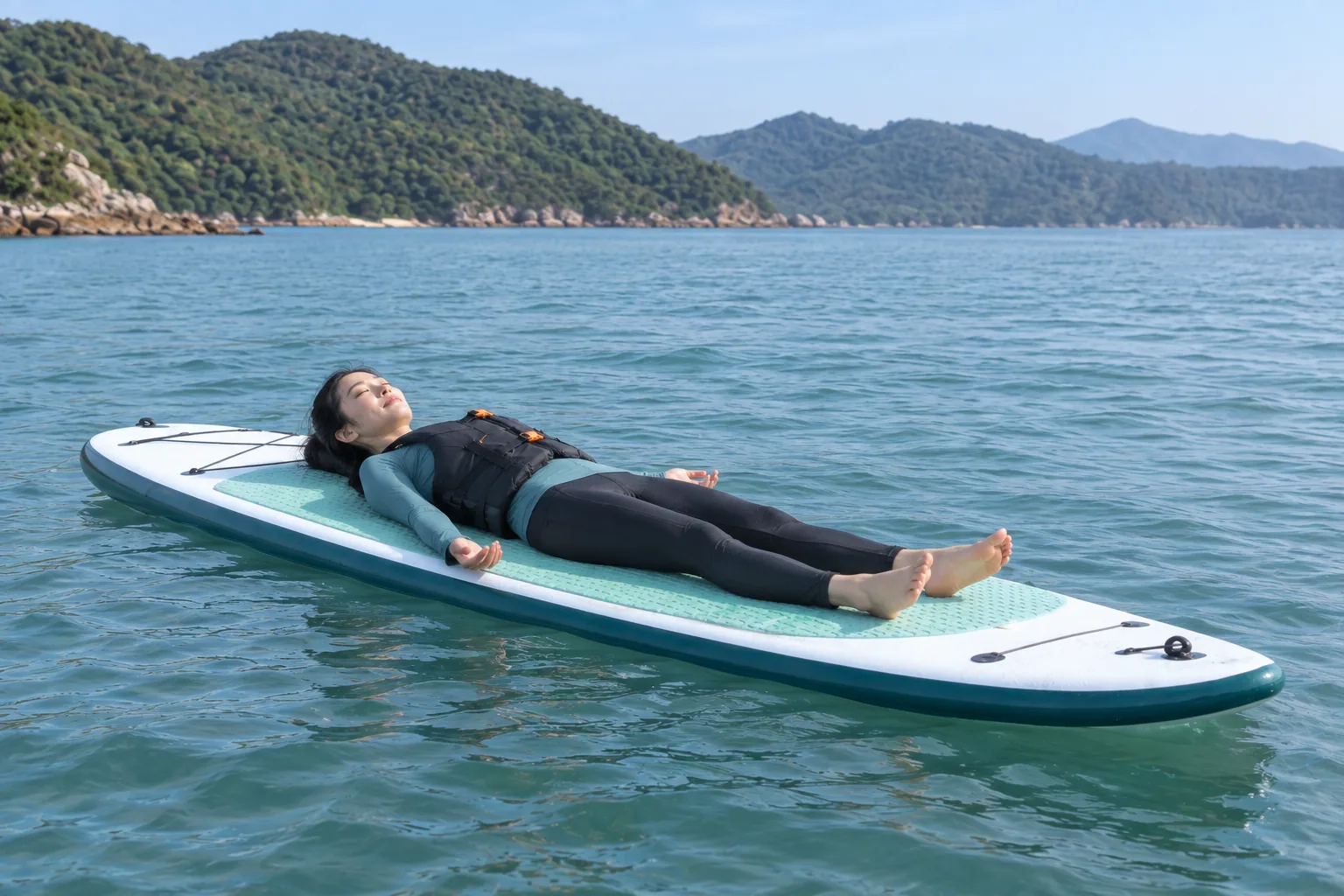
Practice focus:Finish comfortably; you do not need to complete every pose before taking a rest.
Keep every movement comfortable and pain-free. Tell your instructor immediately if you feel pain, dizziness or unease. The names and grouping follow REI’s SUP Yoga reference; descriptions and images have been adapted for this article. Follow the guidance given during your session.
Prefer to get started with an instructor? Check the available dates and activity details.
What to wear and bring
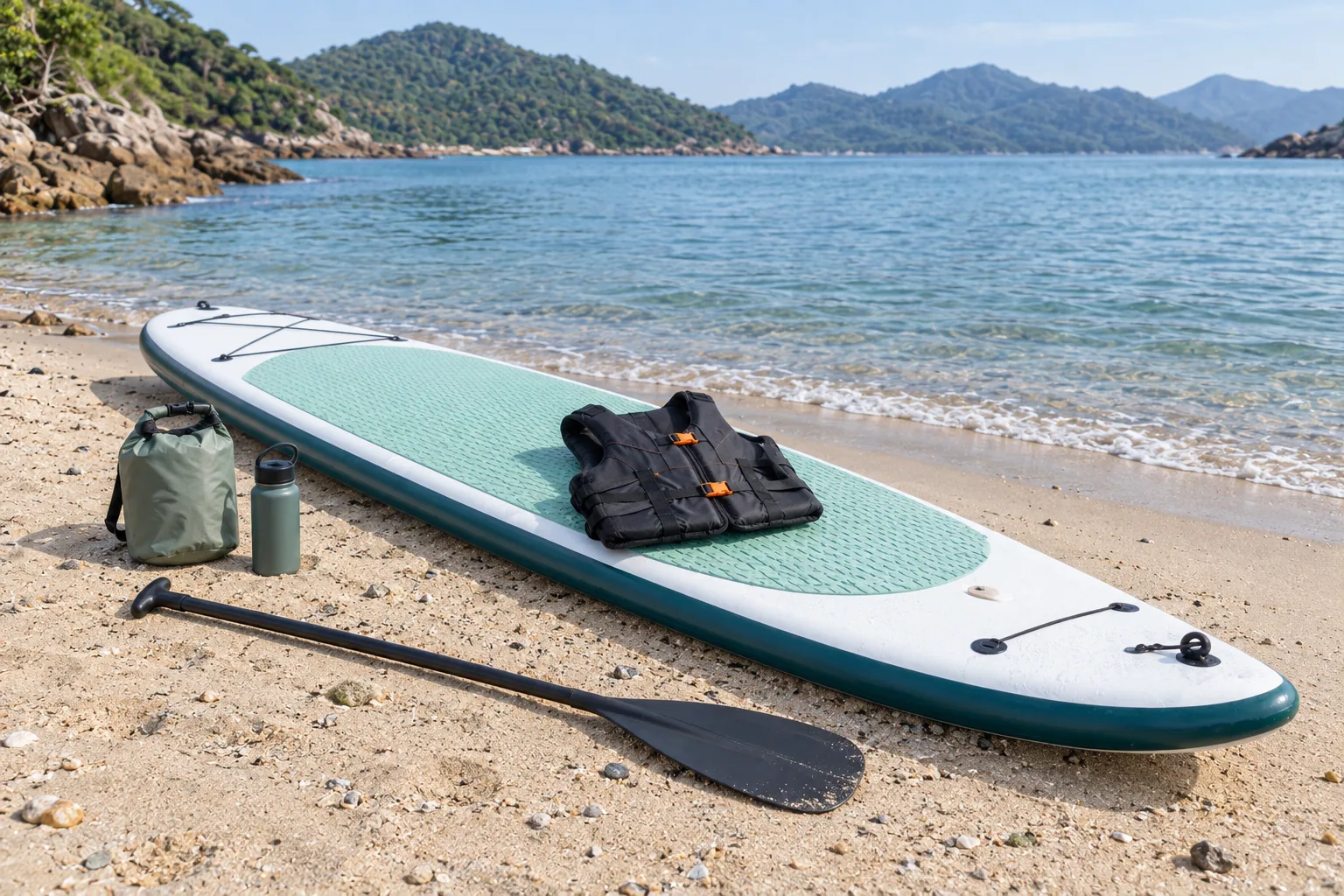
- Wear swimwear or quick-drying clothes that allow movement; a long-sleeved rashguard is another option.
- Bring drinking water, sun protection, a towel and dry clothes. Use a suitable retaining strap for sunglasses.
- Protect phones and other water-sensitive belongings, and leave unnecessary valuables behind.
- Check the meeting point and time in your confirmation. Allow additional time if you need to change.
Sea conditions and safety come before completing poses
⚠️ Practise with an appropriate instructor and use buoyancy equipment as directed. Do not remove equipment for photographs or independently attempt inversions and single-leg poses. Wind, boat wakes and thunderstorms can affect plans. If you have an injury, are pregnant or have health concerns, check suitability with a qualified healthcare professional and the activity provider before booking.
Preparing for different seasons
| Season | Preparation |
|---|---|
| Spring | Check current weather and available sessions, and bring dry clothing for after the activity. |
| Summer | Plan for heat, sunshine and possible thunderstorms; use sun protection, drink water and follow rest instructions. |
| Autumn and winter | Consider wind, water temperature and suitable clothing. Confirm available sessions rather than assuming daily year-round departures. |
Seasonal notes help with preparation; actual departures depend on weather, sea conditions and the provider's confirmation.
Join a guided experience or rent a board?
If you want to learn yoga on a board, or are new to SUP, an instructor-led SUP Yoga experience is a suitable starting point. Experienced paddlers who mainly want an independent outing can check SUP rental separately. Rental and yoga instruction are different services, so choose according to your ability and the listed inclusions.
Already have paddling experience? Explore SUP rental
FAQ
Can I join without yoga or SUP experience?
The Kayarine activity page lists the experience for ages 12 and above, with no yoga or SUP experience required. Beginners can first get comfortable with the equipment and moving board, then follow instructor-led practice. Check your personal suitability and the session requirements before booking; completing every illustrated pose is not expected.
Can non-swimmers definitely take part?
A buoyancy aid alone does not establish suitability. Tell the provider about your swimming ability, comfort around water and relevant health concerns before booking, so they can confirm the requirements for that session. Follow the instructor's directions throughout, and consider another suitable activity if you remain uncomfortable in the water.
Do I need to bring a paddleboard or yoga mat?
The activity page lists a rigid SUP board, paddle, buoyancy aid and instructor guidance as included, so you do not need to bring a complete SUP setup. Practice takes place on the deck. Check the booking page and confirmation for personal items, clothing and meeting arrangements, and ask beforehand about any specific equipment needs.
How long is it, and where can I check prices?
The activity page currently lists approximately two hours, including a briefing, paddling, yoga and free time. The schedule can change with sea conditions. On the SUP Yoga booking page, choose your booking mode, date and party size to see the per-person price, availability and order total before proceeding.
What if the weather is poor or a pose is too difficult?
The provider will advise on rescheduling or cancellation in adverse weather; consult your latest confirmation and booking policy. Poses are adapted to conditions, ability and comfort, so you do not need to perform every image. Stop and tell your instructor promptly if any movement causes pain or makes you feel unwell.
Plan your SUP Yoga experience in Sai Kung
Check the available dates, per-person prices and participation details, then choose a session that suits you.