
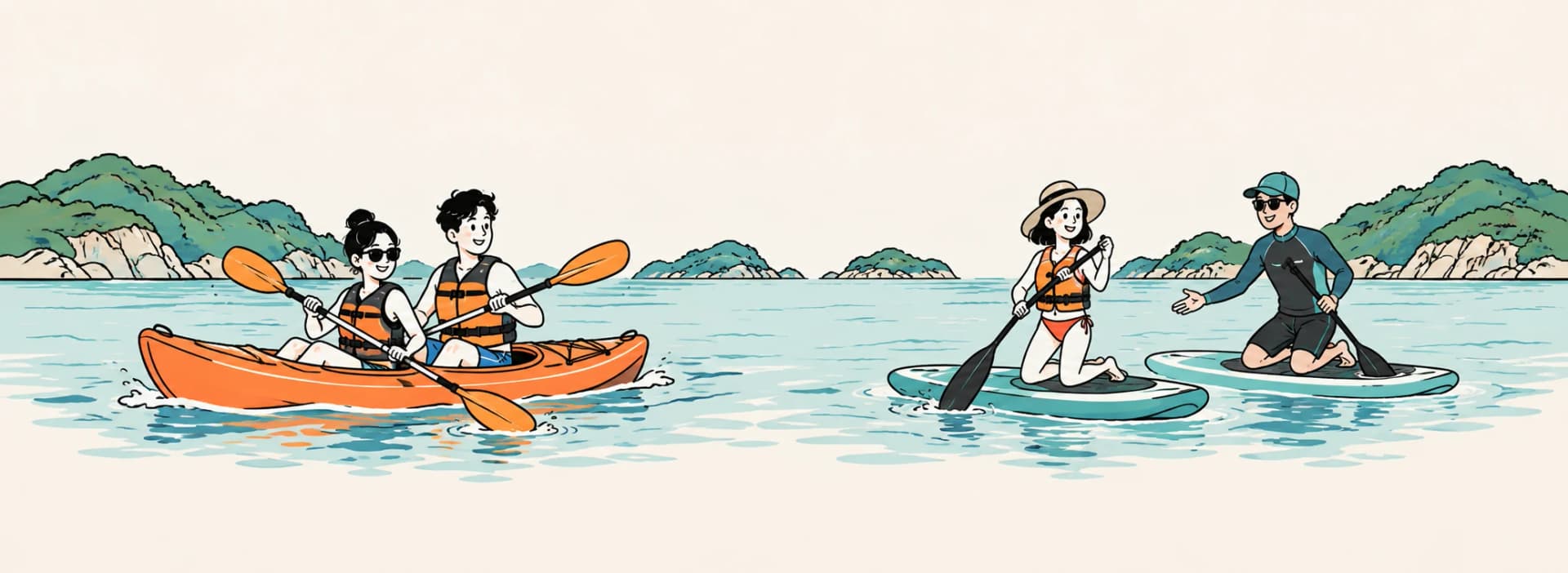
Both kayaking and stand-up paddleboarding can give colleagues a memorable day on the coast. The better choice depends on who is joining and what you want the event to achieve. Begin with the group's confidence and preferences, rather than choosing solely for the photographs.
A quick comparison
| Consideration | Kayaking | SUP |
|---|---|---|
| Starting out | Seated paddling may feel more familiar; basic instruction is still needed. | Beginners can start kneeling before trying to stand. |
| Working together | Tandem paddlers need to agree on direction and timing. | Usually individual control, with opportunities to encourage others. |
| Confidence and effort | Often appealing to people who prefer a seated activity. | Suits people interested in a balance challenge; adaptation is possible. |
| Photographs | Boats can provide a shared group scene when conditions allow. | Individual paddling and learning moments make lively images. |
| Getting wet | Splashes and capsizing are possible. | Falling into the water is a normal possibility during learning. |
| Group logistics | Tandem boats pair participants; supervision still depends on the group. | Board numbers, space and instructor capacity shape the programme. |
Why choose kayaking for team building?
A tandem kayak gives two colleagues an immediate shared task. They need to communicate, coordinate their strokes and adjust together. Pairing people from different departments can create conversation without a formal icebreaker. Seated paddling may also appeal to colleagues who feel less comfortable attempting a standing activity.
Kayaks can make an attractive group photograph, but the instructor should decide where and when boats can gather. Props or photographs must not interfere with paddling, supervision or safety equipment.
What does SUP offer?
SUP turns a new skill into a small personal achievement. Participants can practise their balance and paddle control at an appropriate pace, encouraging one another as they progress. Standing is not the only way to begin: kneeling can form part of the learning process.
For a group interested in a particular experience, ask about options such as SUP yoga or a sunset session and whether they suit the participants and available dates. Do not assume that a visually striking activity is suitable for every person.
Match the activity to people and purpose
If the priority is cooperation and conversation, tandem kayaking is a useful option to discuss. If the team wants to learn a new skill and is comfortable with the possibility of falling in, SUP may be appealing. Age alone is not a reliable guide: ask about confidence, preferences and relevant physical needs.
For larger groups, confirm how participants will be divided, how many instructors will accompany each group and how the schedule will work. Neither activity has a universal safe group size.
Consider a mixed programme
A combination can accommodate different interests. Some colleagues can kayak while others try SUP, or groups may rotate if the operator confirms that the timing, equipment and conditions allow it. Discuss any games with the instructors first; novelty should not compromise supervision.
Check the practical and safety arrangements
Confirm the briefing, life-jacket fitting, supervision, return-to-shore arrangements and weather decision process. Tell the operator about swimming confidence and any health concerns before booking. Bring a change of clothes and suitable sun protection regardless of the activity chosen.
Ask Kayarine about a programme for your team, or browse the activities.
Frequently asked questions
Do participants need to be sporty?
Previous experience is not always necessary, but suitability depends on the person and the programme. Discuss concerns in advance so the pace and activity can be considered.
Which is better for cooperation?
A tandem kayak requires two people to work together directly. SUP can also include group encouragement and appropriately planned tasks.
What works for a large company group?
Ask for a plan showing group divisions, equipment and instructor coverage. A kayaking or mixed programme may work, subject to the operator's assessment.
Will everyone get wet?
Prepare for it. Kayakers can be splashed or capsize, and SUP participants may fall in while learning.
What happens in bad weather?
Follow the operator's instructions and the conditions agreed for the booking. Discuss backup dates and the decision process before confirming the event.