
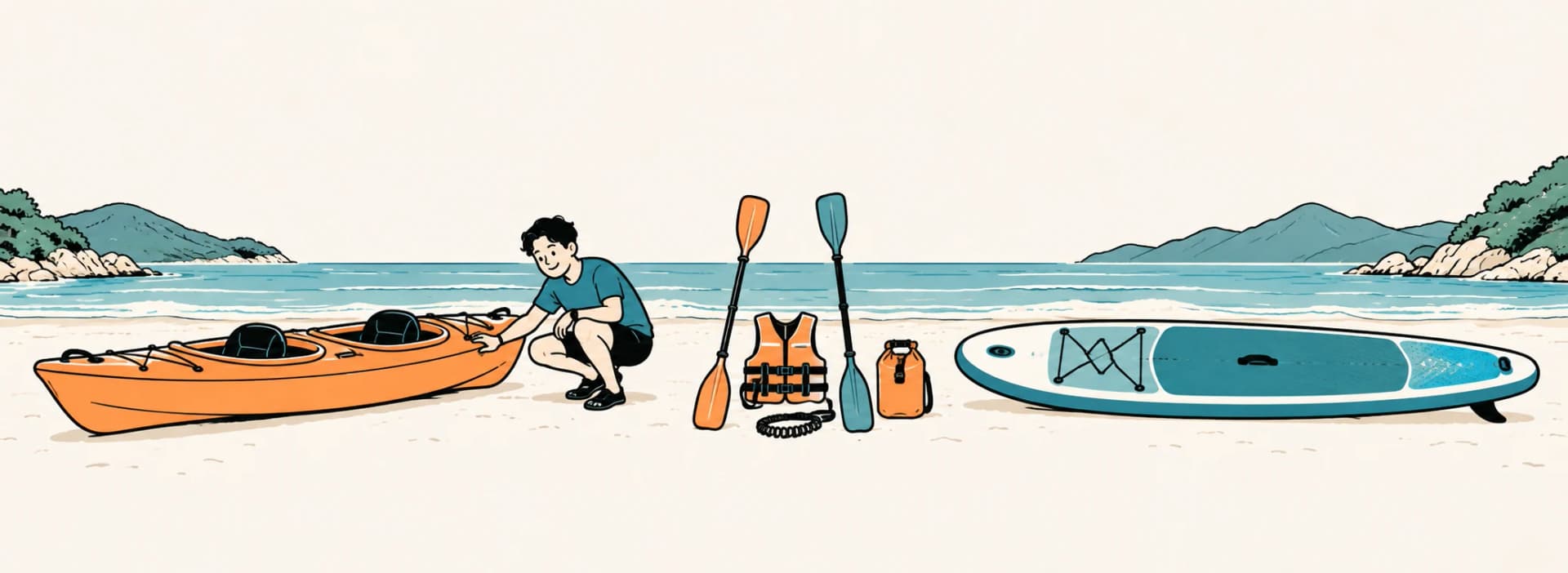
When comparing a water-activity programme, ask about the equipment as well as the route and price. The kayak or SUP needs to suit the paddler, the intended use and the conditions. For a group with different levels of experience, well-maintained equipment and consistent preparation are especially important.
Kayarine uses hard-shell kayaks and rigid SUP boards for its group water activities. Here is what that choice means in practice, and what organisers should still check. No construction type removes the risks of being on the water.
Compare the complete equipment, not just the material
| Consideration | Hard-shell kayak or rigid SUP | Inflatable kayak or SUP |
|---|---|---|
| Structure | Keeps its designed shape without inflation. Inspect the hull or board for damage. | Depends on the design, construction and correct operating pressure. |
| Handling | Shape, dimensions, loading and paddler skill affect performance. | The same factors matter, together with appropriate inflation and condition. |
| Stability | Depends on the model, load, paddler and water conditions. | Also varies by model, load, paddler and conditions; material alone is not a safety rating. |
| Damage checks | Look for cracks, wear and damage to fittings or buoyancy components. | Check seams, valves, surfaces and pressure according to the manufacturer. |
| Group use | A familiar, consistently maintained fleet supports preparation and supervision. | Suitable models also require consistent maintenance, checks and operator assessment. |
Why use hard-shell kayaks?
A rigid hull keeps its designed form without needing inflation. In a suitable kayak, this can provide predictable handling for instruction. Instructors can become familiar with a fleet's turning response and loading characteristics, making briefings and equipment allocation more consistent.
A hard shell is not indestructible. Rocks, sharp shells, impacts and wear can damage equipment. Paddlers should avoid collisions, follow landing instructions and report damage rather than assuming a scratch is harmless. Stay within the manufacturer's capacity and use the equipment as directed.
Why choose rigid SUP boards?
Rigid boards offer a fixed shape and flex characteristics that the instructor can account for when matching a board to a participant. Board width, volume, shape and the paddler's weight and skill all affect the experience. A rigid board can still be unstable for a particular person or unsuitable for particular conditions.
Inflatable boards are not automatically unsafe. Suitability depends on the specific product, its condition, correct setup, intended environment and the operator's assessment. Thickness or material alone cannot establish which board will handle wind better. All SUPs are affected by wind and currents.
The sea requires more than reliable equipment
Sai Kung's coastal conditions can change with wind, tide and swell. Equipment that feels manageable in sheltered water does not guarantee a safe trip on an exposed route. The route, participants, supervision and return plan must be assessed together.
Follow instructions on flotation equipment and any other safety accessories. Do not set out in unsuitable conditions simply because the kayak or board is rigid. Reliable equipment supports good decisions; it cannot replace them.
What should a group organiser ask?
Ask how the operator checks the fleet, selects suitable equipment for each participant and briefs beginners. Confirm instructor coverage, life-jacket fitting and the response to a change in sea conditions. Tell the team about swimming confidence, health or mobility concerns before booking.
For larger groups, also ask how equipment and instructors will be allocated across smaller groups. Consistency should come from maintenance and preparation, rather than an assumption that every boat behaves identically.
Discuss a group programme with Kayarine, or view equipment rental services.
Frequently asked questions
Are inflatable SUPs always unsafe?
No. Evaluate the specific equipment, its intended use, condition and setup together with the environment and paddler. Construction alone does not establish safety.
Can a hard-shell kayak capsize?
Yes. No kayak is capsize-proof. Use correctly fitted flotation equipment, follow instruction and respect conditions and capacity limits.
Can someone who cannot swim participate?
Tell the operator before booking so suitability and support can be assessed. The use of rigid equipment does not by itself answer that question.
How many people can join a group activity?
Capacity depends on the programme, equipment, instructors, participants and conditions. Ask for a plan for your expected headcount.
What happens if the weather changes?
Follow the instructor's directions and the booking's weather arrangements. Equipment choice is never a reason to continue in unsafe conditions.
Further reading: RNLI paddleboarding safety.