
Beginner Surfing Guide: Boards, Paddling, Pop-Ups, Wave Reading and Safety
🌊 Part 1: How Surfing Works, Choosing a Board and Reading the Forecast
Surfing involves balancing your body and board while a moving wave provides forward momentum.
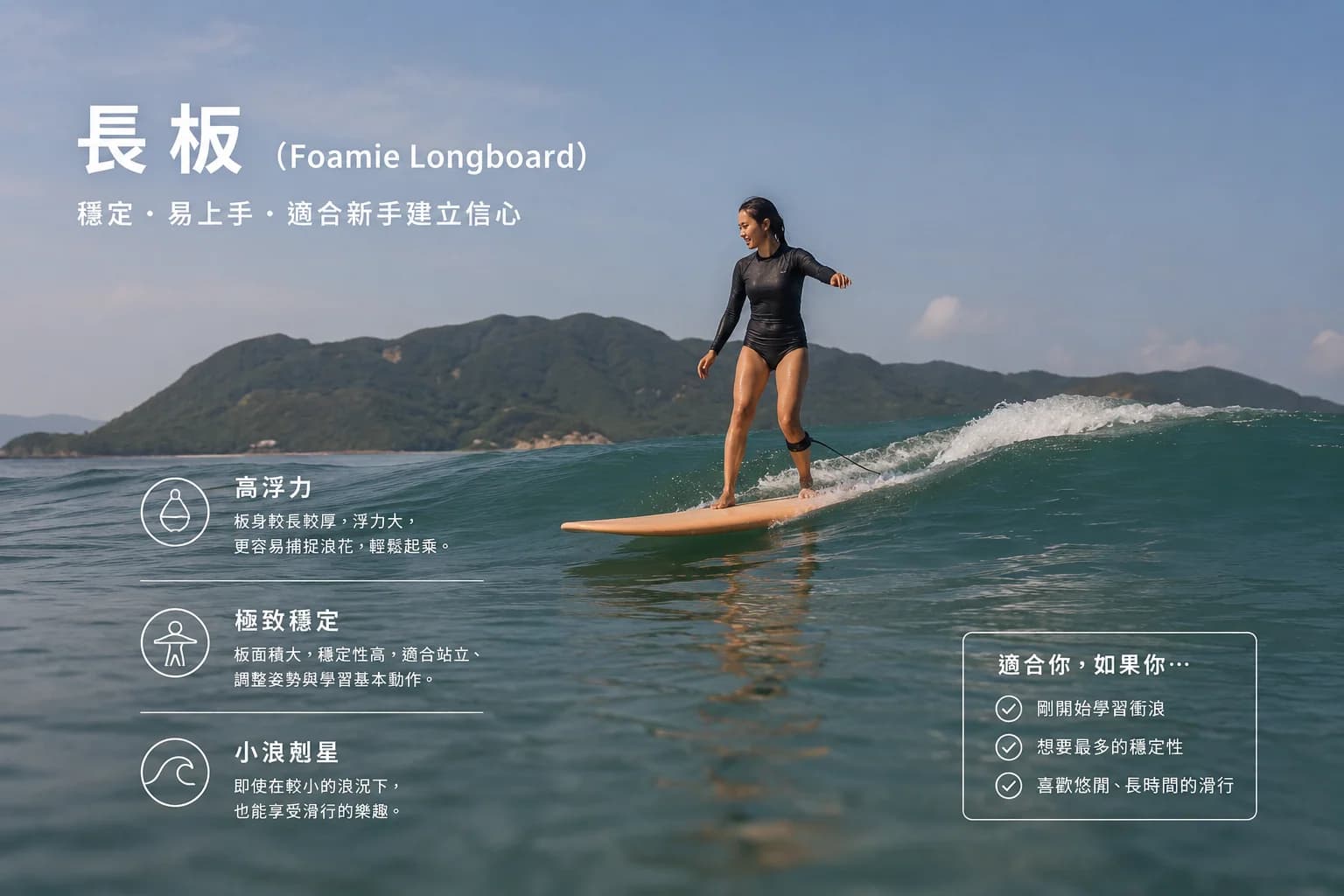
Why start with a long soft-top board?
Shortboards may look appealing, but starting on one can make catching waves unnecessarily difficult. A suitable beginner board gives you more opportunities to practise.
- Buoyancy and volume: Board volume is measured in litres and influences flotation. As a broad example, an adult weighing 60–80 kg might learn on a high-volume board around 70–90 litres. Longer soft-tops can provide stability, but a surf school should select the size for your weight, ability and conditions.
- Paddling speed: To catch a wave, you need enough forward speed for it to carry the board. A longer beginner board generally glides and paddles more easily than a small, low-volume shortboard, giving you a more forgiving start.
- Impact protection: Soft-top boards use foam-covered surfaces and may have flexible fins. These can reduce the severity of some collisions compared with hard boards, but they do not eliminate injury risk or make large surf suitable for beginners.
Swell Height and Period
These are important forecast figures, but neither tells you on its own whether a beach is suitable:
- Swell height: This describes incoming swell offshore, not necessarily the height of breaking waves at your beach. The original guide’s 0.5–1.2 m range is not a universal beginner safety limit; ask a local instructor to choose suitable conditions.
- Swell period: Measured in seconds, this is the interval between successive waves. Longer-period swell can carry substantially more energy and requires careful assessment.
- Around 5 seconds or less: Often short, locally generated wind waves, which may be choppy and less organised.
- Around 7–9 seconds: Can produce more organised surf in Hong Kong, depending on the beach, wind and swell direction.
- 10 seconds or more: Longer-period swell can produce powerful breaking waves. Typhoons and strong weather systems can generate dangerous conditions; a promising forecast number is not a reason to enter the water.
Wind Direction and Speed
Wind affects the shape and texture of the wave surface:
- Offshore wind: Blows from land towards the sea and can hold up wave faces. However, strong offshore wind can carry people and boards away from shore. At a generally south-facing beach such as Cheung Sha, northerly wind may be offshore, depending on the exact section.
- Onshore wind: Blows from sea towards land and often makes the surface choppier and wave faces less clean.
- Cross-shore wind: Blows along the beach and can create uneven surface conditions.
- Note: Light wind can produce smoother, or ‘glassy’, water, but wind speed alone cannot establish that it is safe to surf.
Tides
Changing water levels alter where and how waves break over the seabed.
- High tide: Deeper water can mean waves break abruptly near shore at some beaches, creating a challenging shore break.
- Low tide: Shallower water can make waves break more quickly or expose rocks and other hazards.
- Choosing a tide: Mid-tide can work at some beaches, but there is no universally best tide. Ask an instructor about the specific break and how conditions will change during your session.
Swell Direction
Check where the swell is coming from and whether headlands or islands shelter the beach:
- For example, Cheung Sha’s generally southerly orientation makes southerly swell relevant. Swell approaching from other directions may be reduced or reshaped by the surrounding coastline and islands, so an offshore forecast does not guarantee surf at the beach. 🔍 Forecast resources
- Hong Kong Observatory: Check marine forecasts, warnings, wind observations and tide predictions relevant to your intended location.
- Surfline and Windy: These services display useful forecast information such as swell, wind and, where available, tides. Ratings and models are planning aids, not a replacement for local assessment.
🦹♂️ Part 2: Three Core Skills to Practise on Land and in a Lesson
Surfing uses the back, shoulders, trunk and legs. Paddling, controlling the board and standing up each place different demands on strength, mobility and coordination.
Lying on the Board and Paddling
Paddling takes up a large part of a surf session and is central to catching waves.
- Trim: Find a position where the board lies fairly level and the nose stays just clear of the water. Too far forward and the nose may dive; too far back and the raised nose creates drag. The exact position depends on the board.
- Body position: Keep your torso centred, your chest comfortably lifted and your legs close together. Avoid forcing an extreme back arch; aim for a stable position that lets you paddle freely.
- Paddling technique: Alternate your arms, placing each hand into the water and drawing it back close alongside the board. Use a controlled stroke and your larger back muscles rather than relying only on your arms.
Approaching and Catching a Wave
- Look back: Watch approaching waves and surrounding surfers. In a beginner lesson, your instructor will help you turn towards shore and start paddling at an appropriate time.
- Build speed: Increase your paddling effort as the wave approaches. When the tail lifts and the board begins moving forward under the wave’s power, you may be close to catching it.
- Keep paddling briefly: Standing too early can leave the wave behind. Continue until the board is travelling with the wave, using your instructor’s timing cues rather than a fixed number of strokes.
The Pop-Up
Work towards a smooth movement into your stance. Beginners may learn a staged technique before progressing to a faster pop-up; control matters more than meeting a one-second target.
- Hand placement: Place your palms on the deck beside your lower chest. Avoid gripping the rails, which can make the board less stable.
- Push and bring the feet underneath: Press your upper body up and bring your feet beneath you, using a technique appropriate to your mobility and the board. Practise with an instructor before attempting it in moving surf.
- Stance and Balance:
- Foot position: Place one foot forward and the other behind, with your weight centred over the board’s lengthwise centre line. Your body faces sideways; do not place both feet next to each other across the board.
- Weight distribution: Keep your knees bent and your stance relaxed and low. Weight shifts between your feet to control speed and direction; a fixed 60/40 split is not a rule for every situation.
- Where to look: Look towards your intended direction of travel rather than down at your feet. This helps you maintain a balanced posture and watch for other water users.
🗺️ Part 3: Water Safety and Reading the Ocean
Learning to recognise hazards is essential. Observe the beach and speak with a lifeguard or instructor before entering.
Recognising and Responding to Rip Currents
Rip currents are concentrated flows moving away from shore. They can carry people beyond the breaking waves and are a serious beach hazard.
- Possible signs: A gap in breaking waves, darker water or foam and sediment moving seaward can indicate a rip. Rips are not always visible, and a calm-looking patch is not proof of safety.
- If caught: Stay with your board and signal for help. Do not exhaust yourself trying to paddle directly against the current. If able, move parallel to shore to leave the flow, then return towards shore. If you cannot escape, conserve energy and keep signalling.
Parts of a Breaking Wave
- Peak: The highest section that begins breaking first. More experienced surfers use its position when choosing a take-off point.
- Face: The sloping, unbroken part of the wave on which a surfer travels after taking off.
- Whitewater: The foamy water after a wave breaks. Small, gently spilling whitewater is commonly used for beginner practice, in an area and depth chosen by an instructor.
- Impact zone: The area where waves break with force. Beginners should avoid heavy breaking waves and follow the instructor’s choice of practice area.
🤝 Part 4: Surf Etiquette
Sharing waves responsibly helps prevent collisions and makes the water more welcoming for everyone.
Right of way: Respect the surfer with priority nearest the breaking peak. Do not take off in front of someone already riding the wave; this is called dropping in.
Paddling out: Avoid crossing the path of a surfer riding the open face. Follow a safe route identified by your instructor and give riding surfers room.
Keep control of your board: Do not casually release a board towards other people. A board and extended leash can reach a considerable distance. Maintain generous spacing and learn appropriate ways to handle incoming whitewater; do not enter surf beyond your ability to control your equipment.
🎒 Part 5: Wipeouts, Energy and Confidence
- Wipeouts: Falling is part of learning. Protect your head with your arms, avoid diving head-first and be aware of shallow water and your board. As you surface, keep your head protected and check your surroundings. Do not rely on a fixed hold-down duration or pull yourself up by the leash.
- Keep energy in reserve: Surfing is tiring. Finish before you become exhausted. If your paddling slows or your arms feel fatigued, tell your instructor and return to shore safely for a rest.